
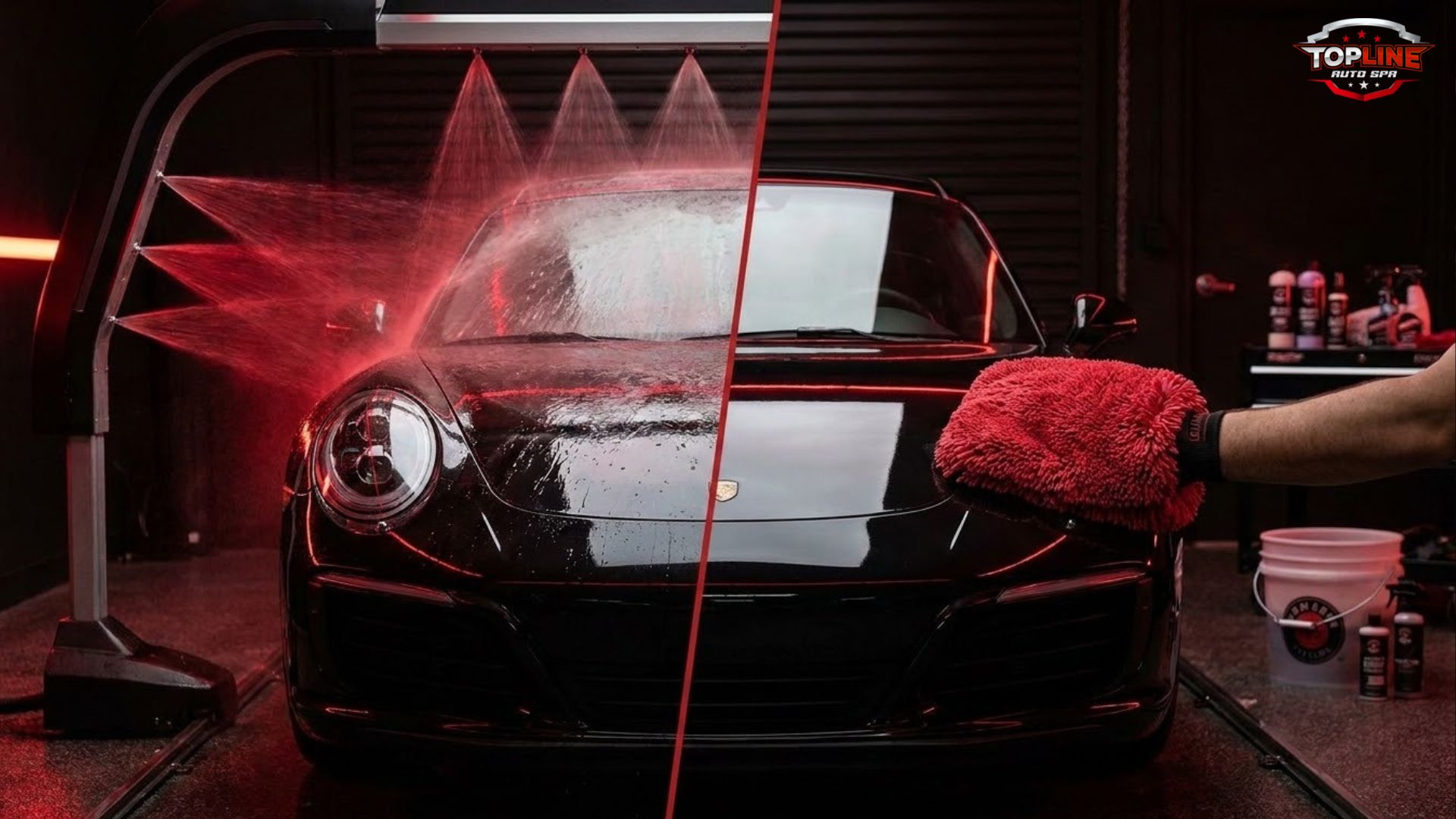
You pull into a touchless car wash, watch jets of water blast away the dirt, and drive off in two minutes. Clean car, zero effort. But is it actually safe for your paint?
Or maybe you prefer the hands-on approach: bucket, mitt, and elbow grease. More control, but more room for error, too.
The truth is, both methods can protect or damage your paint depending on how they’re done. This guide breaks down the real difference between touchless car wash and hand wash, so you can make the best choice for your vehicle.
Key Takeaways
- Touchless car washes use high-pressure water and harsh chemicals. No brushes, but not entirely risk-free
- Hand washing gives you more control but introduces the risk of swirl marks and scratches if done incorrectly
- Both methods can damage paint when done wrong
- Proper technique matters more than the method you choose
- Ceramic coatings and paint protection can make both methods significantly safer
What Is a Touchless Car Wash?
A touchless car wash uses high-pressure water jets and strong chemical detergents to clean your car without any physical contact. There are no brushes, no foam pads, no cloths. Just water and chemicals doing the heavy lifting.
Pros of Touchless Car Wash
- No physical contact means no risk of brush-induced scratches
- Fast and convenient — usually done in under 5 minutes
- Consistent process — no human error in the washing technique
- Good for light dirt and dust — handles surface grime well
Cons of Touchless Car Wash
- Harsh chemicals: To compensate for the lack of scrubbing, touchless systems use aggressive detergents that can strip wax, sealants, and even degrade older paint over time
- High-pressure water: Can force water into door seals, trim gaps, and paint chips, potentially causing rust or peeling
- Not effective on heavy dirt: Baked-on mud, bird droppings, and tar often require physical agitation to remove fully
- No drying step: Many touchless systems skip proper drying, leaving water spots
What Is a Hand Wash?
Hand washing means cleaning your car yourself (or through a professional detailer) using a wash mitt, two-bucket method, pH-balanced car shampoo, and proper drying technique.
Pros of Hand Wash
- Gentle on paint when done correctly. A quality microfiber mitt causes minimal friction
- Better cleaning: You can target specific areas, remove contaminants effectively, and use proper lubrication
- You control the products: Choose paint-safe, gentle formulas
- Works well with protective coatings: Safe for waxed or ceramic-coated vehicles
Cons of Hand Wash
- Time-consuming: A proper hand wash can take 30 to 60 minutes
- High risk of swirl marks: Wrong mitt, dirty water, or poor technique can scratch your clear coat
- Physical effort: Not ideal for everyone, especially on larger vehicles
- Inconsistent results: Depends heavily on the person doing it
Common Mistakes That Damage Paint (Both Methods)
Whether you’re going touchless or washing by hand, these are the mistakes that actually damage your paint:
Touchless Car Wash Mistakes:
- Using it too frequently with strong chemical formulas
- Relying on it to remove heavy contaminants like tar, sap, or bird droppings
- Not following up with a proper wax or sealant to replace stripped protection
Hand Wash Mistakes:
- Using a single dirty bucket. This drags abrasive dirt particles back across your paint
- Washing in direct sunlight. Soap dries too fast and leaves residue
- Using dish soap or household cleaners. These strip protective coatings
- Drying with old terry cloth towels. They create fine scratches on the clear coat
- Skipping a pre-rinse. Dry-rubbing loose dirt into the paint with your mitt
If your paint already has swirl marks or scratches from previous washes, you may need paint correction near me before applying any new protection.
How to Make Any Wash Method Safer
Regardless of which method you choose, these steps will protect your paint:
For Touchless Car Wash:
- Avoid frequent use of harsh chemical systems. Once every few weeks is fine for light maintenance
- Follow up with a spray wax or quick detailer after washing
- Inspect your paint afterward for water spots and address them promptly
- Avoid touchless washes if your paint has chips or exposed metal
For Hand Wash:
- Always use the two-bucket method: one for soapy water, one for rinsing the mitt
- Use a quality microfiber wash mitt, never a sponge
- Pre-rinse thoroughly to remove loose dirt before touching the paint
- Work top to bottom, section by section
- Dry with a clean microfiber drying towel using a patting motion, not wiping
The best long-term protection you can add to either routine is a quality ceramic coating. It creates a hard, hydrophobic layer over your paint that makes both wash methods safer. Water and dirt bead off instead of bonding to the surface. If you’re in the Lehigh Valley area, a professional ceramic coating Lehigh Valley PA service can apply this protection properly, ensuring full coverage and long-lasting results.
Which One Is Safer for Your Car?
Here’s the honest answer: hand washing is safer for your paint when done correctly.
Touchless car washes are convenient and eliminate brush-related scratching, but the chemical trade-off is real. Frequent use of high-pH detergents degrades wax, dulls ceramic coatings over time, and can accelerate paint oxidation, especially on older vehicles.
That said, a properly executed touchless wash beats a poorly done hand wash every single time. Dragging a dirty mitt across your hood will do more damage than a well-calibrated touchless system.
For the best results: hand wash when you have the time and tools to do it right. Use touchless washes for quick maintenance between deep cleans, but don’t rely on them as your only care routine.
If you’re unsure where your car stands, it helps to understand the full picture. Check out our guide on Car Wash vs Car Detailing: What’s the Real Difference? to understand what each service actually does for your vehicle’s finish.
Expert Insight: What’s Really Happening to Your Clear Coat
Your car’s paint isn’t just one layer. It’s a primer, base coat, and clear coat system. The clear coat is the outermost protective layer, and it’s only about 50 to 100 microns thick.
Every wash, touchless or by hand, puts some degree of stress on that clear coat. With touchless systems, the concern is chemical erosion. Strong detergents can break down the molecular bonds in wax and sealants, and repeated exposure gradually roughens the clear coat surface. This shows up as dullness, reduced gloss, and eventually oxidation.
With hand washing, the risk is micro-abrasion. Every time a mitt or towel moves across paint, friction happens. The question is whether that friction comes with abrasive contamination (like trapped dirt) or clean lubrication. The two-bucket method and a quality shampoo minimize that friction dramatically.
Paint protection, whether wax, sealant, or ceramic coating, acts as a sacrificial layer. It absorbs the chemical and physical stress before it ever reaches your actual paint. This is why professionals always recommend washing a protected car rather than bare paint.
For vehicles that go through frequent washing cycles or are exposed to harsh environments, professional detailing services go beyond what any wash method can do at home. A full service auto detailing near me includes clay bar treatment, decontamination, paint enhancement, and reapplication of protection, essentially restoring and sealing your paint from the ground up.
Conclusion
The debate between touchless car wash and hand wash doesn’t have a one-size-fits-all answer, but it does have a clear winner when the conditions are right.
Hand washing, done properly with the right tools and technique, is the safest method for your paint. It gives you control over every product that touches your car, allows you to address problem spots directly, and works in harmony with whatever protective coating you have in place. Done consistently and correctly, it keeps your paint looking sharp for years.
Touchless car washes have a real place in any car care routine. They’re fast, they’re convenient, and when used as a supplemental wash between deeper cleans, they cause minimal harm. The key is not over-relying on them and ensuring your paint has adequate protection: wax, sealant, or a ceramic coating, so the harsh chemicals have a sacrificial barrier to work against rather than your clear coat directly.
What ultimately damages paint most isn’t the wash method itself. It’s neglect, inconsistency, and using the wrong products. A car that gets a proper hand wash monthly will always be in better shape than one that gets a touchless wash weekly with no follow-up protection.
The smartest approach is a layered one: start with professionally corrected, protected paint. Maintain it with careful hand washing. Use touchless methods when time is short. And schedule a professional detail once or twice a year to reset the surface and reapply protection. That combination, not one method alone, is what keeps your car’s finish genuinely protected over the long haul.
Frequently Asked Questions
Q: Can a touchless car wash damage new car paint?
Yes, it can, particularly if the new paint hasn’t been properly protected with a sealant or ceramic coating. New cars often leave the dealership with minimal paint protection, making them vulnerable to the high-pH chemicals used in touchless systems. It’s worth adding a protective layer before running your new car through any automated wash.
Q: How often should I hand wash my car?
For most drivers, every two weeks is a good baseline. If you park outdoors, drive in dusty or salty conditions, or notice bird droppings or sap, wash sooner rather than later. These contaminants are acidic and can etch through clear coat within days if left untreated.
Q: Is hand washing better than a touchless wash for a ceramic-coated car?
Hand washing is generally the recommended method for ceramic-coated vehicles. While a ceramic coating does add resistance to chemicals, frequent exposure to harsh detergents in touchless systems can gradually reduce the coating’s hydrophobic properties over time. Hand washing with a pH-neutral shampoo preserves the coating’s performance and extends its lifespan significantly.