
Your windshield is arguably your most important safety feature. Without a clear view of the road, nothing else matters—not your responsive brakes, not your advanced stability control, not even your airbags. Yet most drivers give their windshield minimal thought until it’s damaged beyond repair.
This disconnect is understandable. Your windshield works silently in the background, collecting dirt, rain, salt spray, and environmental damage while you’re focused on driving. By the time you notice the problem, permanent etching or pitting has already begun. The damage is expensive to repair and potentially dangerous to ignore.
The good news? Modern windshield protection technology has evolved dramatically. Windshield ceramic coating—a professional-grade treatment using advanced water beading technology—offers a solution that seems almost too good to be true until you experience it firsthand. Clear water beads rolling off your windshield. Reduced dependence on wipers. Dramatically easier cleaning. These benefits transform the driving experience, especially in challenging weather conditions.
But what exactly is windshield ceramic coating, and how does the water beading technology actually work? More importantly, is it worth the investment for everyday drivers? This comprehensive guide answers these questions and explores why serious car owners are adding windshield ceramic coating to their vehicle protection strategy.
Key Takeaways
- Windshield ceramic coating uses nanotechnology to create an invisible hydrophobic layer that transforms how water interacts with glass
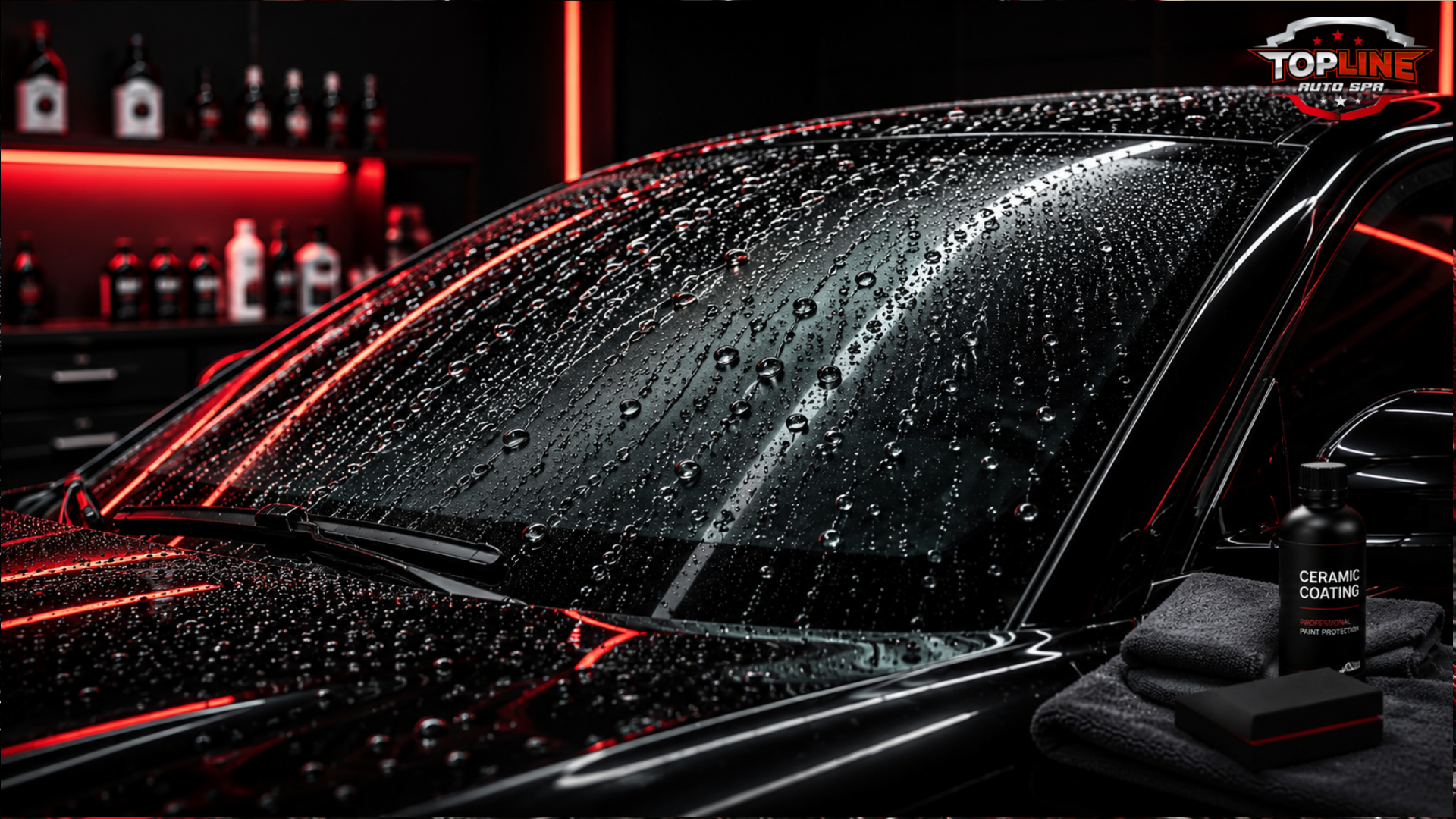
- Water beading technology works by increasing surface tension, causing water to form distinct droplets that roll away rather than sheet across the glass
- The coating provides genuine safety benefits through improved visibility, reduced glare, and less reliance on wipers in wet conditions
- Professional windshield ceramic coating lasts 12-24 months, dramatically longer than traditional treatments like Rain-X
- The hydrophobic surface prevents mineral spotting, salt damage, and contaminant bonding—critical benefits for Lehigh Valley residents facing harsh winters and hard water
- Windshield ceramic coating complements other protective treatments like paint ceramic coating and professional detailing for comprehensive vehicle care
- The investment typically costs $150-300 and delivers benefits that justify the expense through improved safety and reduced maintenance
- Unlike windshield protection film, ceramic coating maintains optical clarity and doesn’t interfere with modern safety features
Understanding Your Windshield’s Hidden Challenges
Before exploring windshield ceramic coating, it’s worth understanding why windshield protection matters. Unlike your car’s paint, which you can polish and refinish, windshield damage is often permanent.
Consider what your windshield encounters daily. In winter, road salt spray coats the glass and begins corroding the surface. Drivers use winter washer fluid with harsh chemicals designed to cut through ice. The salt and chemicals bond to the glass and gradually etch the surface. After several winters, this etching becomes permanent clouding that no amount of cleaning removes.
Summer brings different challenges. Bird droppings are acidic and eat through unprotected glass. Tree sap hardens and bonds chemically to the surface. Pollen sticks stubbornly despite washing. Hard water from car washes leaves mineral deposits that accumulate over months, eventually creating a white haze across the windshield.
Lehigh Valley residents face all these challenges intensely. Our winters are harsh with frequent road salt application. Our hard water is mineral-rich, leaving spots even after proper washing. Spring and summer bring pollen, tree debris, and intense heat that accelerates contamination bonding.
Highway driving adds another dimension. Rocks and debris create tiny chips that expand into larger cracks. UV exposure degrades the glass itself. The combination of challenges means windshields face a finite lifespan before replacement becomes necessary.
Traditional windshield treatments haven’t adequately addressed these problems. They’re temporary solutions requiring frequent reapplication. This is where modern windshield ceramic coating changes the game fundamentally.
What Is Windshield Ceramic Coating and How Does It Work?
Windshield ceramic coating is fundamentally different from the windshield treatments most drivers have tried. It’s not a wax or a polish or a temporary sealant. It’s a professional-grade nanotechnology product that bonds permanently to glass at the molecular level.
The chemistry is sophisticated but worth understanding. The coating consists of silicon dioxide (SiO2) nanoparticles—incredibly tiny particles much smaller than anything visible to the naked eye—suspended in a specialized carrier solution. When applied to properly prepared glass, this solution undergoes a chemical reaction with the glass surface itself. The nanoparticles bond with the silicon in the glass, creating a hardened protective layer.
This bonding is crucial to understanding why windshield ceramic coating outperforms traditional treatments. Products like Rain-X sit on top of the glass surface. They’re physical layers that eventually wash away. Windshield ceramic coating bonds with the glass chemically. It becomes part of the glass surface rather than sitting atop it.
The resulting coating is microscopically thin—just a few nanometers thick, which means it’s completely invisible to the eye. You can’t see it when you look at your windshield. But its effects are immediately visible and dramatic. Water doesn’t sheet across the glass anymore. Instead, it beads up into perfect droplets and rolls away. Dirt releases more easily. Visibility improves noticeably, especially in rain.
The curing process is important because it determines final performance. After application, the coating doesn’t immediately reach full hardness. It continues bonding with the glass for 24-48 hours, gradually hardening. This is why professional technicians recommend avoiding rain and washing during the initial curing period. Disturbing the coating before it’s fully bonded compromises durability and performance.
Full curing can take up to a week, with the coating continuing to harden throughout this period. This patience pays dividends—the fully cured coating will outperform it for 12-24 months compared to weeks or months for traditional treatments.
The Science of Water Beading: Understanding Hydrophobic Technology
The most visually impressive aspect of windshield ceramic coating is water beading—watching water form perfect droplets that roll off the glass. But this isn’t just cosmetic. Water beading is a physical manifestation of chemistry at work, and understanding it helps you appreciate why the technology is so effective.
Water naturally wants to spread. Put a drop of water on a clean glass surface and it spreads into a thin film. This spreading happens because water molecules are attracted to the glass surface more strongly than they’re attracted to each other. In chemistry terms, water “wets” the glass.
This wetting behavior is problematic for visibility. When rain falls on an untreated windshield, water spreads across the surface and forms a continuous film. You’re looking through a layer of water rather than through clear glass. Wipers are necessary to maintain visibility, and even between wiper passes, visibility degrades.
Windshield ceramic coating changes this fundamental behavior through hydrophobic chemistry. Hydrophobic literally means “water-fearing.” The ceramic coating creates a hydrophobic surface where water molecules are repelled rather than attracted. Water no longer wants to spread across the surface.
Instead, water molecules bunch together, held by their mutual attraction. They form distinct beads where the water “sticks to itself” rather than spreading on the glass. These beads sit on the coating surface, held there by surface tension. At highway speeds or with gravity, these beads roll away, leaving clear glass behind.
This effect is measurable in terms of contact angle—the angle formed between a water droplet and the glass surface. On untreated glass, water has a low contact angle (roughly 0-30 degrees), appearing flat and spread out. On properly applied windshield ceramic coating, water has a high contact angle (roughly 100-110 degrees), appearing as distinct beads.
The practical implications are substantial. With water beading, you need fewer wiper passes to maintain visibility. You’re spending more time looking through clear glass and less time looking through water films. At night, this means less glare from oncoming headlights. In rain, it means better visibility and safer driving.
What’s remarkable is how natural this all feels once experienced. After driving with ceramic-coated windshield, returning to untreated glass feels primitive. The constant water sheeting and reliance on wipers becomes frustrating by comparison.
Professional Application: Why It Matters More Than Most Realize
The dramatic difference between professional windshield ceramic coating and consumer products comes down to formulation, preparation, and technique. Each element matters, and skipping any creates suboptimal results.
Preparation is Everything
Before any coating goes on the windshield, the glass must be absolutely clean and free of all contaminants. Professional technicians don’t just wash the windshield—they undergo a multi-step decontamination process that most car owners never attempt.
First comes thorough washing with specialized glass cleaners to remove loose dirt and debris. Then comes clay bar decontamination, which removes embedded contaminants like industrial fallout, tree sap residue, and brake dust that regular washing misses. For many windshields, especially in industrial areas or after highway driving, clay bar treatment removes astonishing amounts of embedded grime.
After clay bar treatment comes glass polishing. This removes minor scratches, water spots, and oxidation that might trap the ceramic coating or prevent even bonding. Professional glass polish is different from the compound you might buy at an auto parts store—it’s formulated specifically for automotive glass and creates an optimal surface for coating application.
Only after this thorough preparation does the ceramic coating actually go on the glass. This multi-step process takes time but ensures the coating bonds properly and performs optimally throughout its lifespan.
Professional-Grade Formulations
Consumer windshield coating products and professional formulations look similar in bottles, but they’re fundamentally different. Professional-grade coatings use higher concentrations of silicon dioxide nanoparticles. They’re engineered with better bonding agents that create stronger molecular bonds with the glass.
The carrier solutions are also different. Professional formulations disperse nanoparticles more effectively, ensuring even coating distribution. Consumer products sometimes struggle with particle suspension, potentially leading to uneven application or spotting.
This difference in formulation explains the dramatic durability difference. Consumer products last weeks to a couple months before washing away. Professional products last 12-24 months because they bond more strongly to the glass and resist deterioration better.
Application Technique Separates Good from Great
Even with premium formulation, poor application technique creates poor results. Professional technicians have refined their technique through training and experience. They apply the coating in thin, even layers using specialized applicators designed to ensure perfect coverage.
Application timing matters—each layer must set before the next is applied, and the technician must work at the right pace to prevent the coating from drying unevenly. Streaking, missed spots, or uneven beading performance all result from improper application technique.
Proper application also means correct product spread and layering. A single thick application often performs worse than multiple thin layers. Professional technicians know exactly how many layers deliver optimal performance for the specific product they’re using.
This is why attempting windshield ceramic coating as a DIY project rarely delivers professional results. Even with excellent product, without proper technique, the results disappoint. The coating might look streaky, perform inconsistently, or fail prematurely.
Real-World Benefits: Beyond the Visual Appeal of Water Beading
Water beading captures attention, but the practical benefits of windshield ceramic coating extend far beyond impressive visuals. These benefits translate to measurable improvements in safety, maintenance, and driving experience.
Safety Improvements in Wet Conditions
The primary safety benefit is improved visibility in rain. Studies consistently show that visibility impairment contributes to weather-related accidents. Windshield ceramic coating reduces visibility-impairing water sheets, giving drivers clearer vision during rainfall.
The improvement is quantifiable. Most drivers report needing to use wipers significantly less frequently with ceramic-coated windshields. Where an untreated windshield might require constant wiper use during heavy rain, a ceramic-coated windshield maintains usable visibility with occasional wiper passes. This reduced reliance on wipers means you’re looking through more clear glass and less water film.
For highway driving, this difference is especially significant. Visibility degradation happens faster at high speeds, and the consequences of reduced visibility are more severe. Ceramic coating keeps visibility optimal when you need it most.
Nighttime Glare Reduction
Many drivers don’t realize how much glare affects their nighttime driving. Water sheets on untreated windshields act like a lens, magnifying glare from oncoming headlights and streetlights. This glare causes eye strain and reduces reaction time to sudden changes.
Windshield ceramic coating reduces this glare because water beads rather than spreads. Without the magnifying effect of water sheets, oncoming headlights are noticeably less glaring. Driving at night feels smoother and less fatiguing. For commuters who drive frequently in darkness, this quality-of-life improvement is genuinely valuable.
Dramatic Reduction in Maintenance Requirements
With ceramic coating, windshield cleaning becomes dramatically easier and less frequent. Water slides away naturally, dirt releases without aggressive scrubbing, and mineral deposits form far more slowly.
For busy car owners or those with professional detailing services scheduled regularly, reduced windshield maintenance between services translates to lower overall cost. Professional detailers spend less time on windshield restoration, reducing service time.
The reduced need for washer fluid is another practical benefit often overlooked. You’ll find yourself using washer fluid less frequently because the coating reduces water spotting and contaminant visibility. Over a year, this adds up to meaningful savings.
Extended Windshield Lifespan
Contaminants that bond to untreated glass eventually cause surface damage. Bird droppings are acidic and create etching. Tree sap bonds chemically and damages the surface. Road salt creates pitting. Over years, this cumulative damage requires windshield replacement.
Windshield ceramic coating prevents much of this damage by reducing contaminant bonding. Fewer contaminants stick initially, and those that do stick less tenaciously. This means less aggressive cleaning is needed, reducing potential scratching from wipers or cleaning techniques.
The cumulative result is an extended windshield lifespan. Untreated windshields might require replacement every 5-7 years. Ceramic-coated windshields often remain in excellent condition for 8-10 years or longer. Windshield replacement is expensive (typically $300-500), so extending lifespan delivers real financial benefit.
Water Spot Prevention
Hard water spotting is particularly problematic in areas with mineral-rich water—common throughout Lehigh Valley. Traditional treatments accept water spotting as inevitable. Drivers either tolerate the spots or spend money on frequent professional cleaning.
Windshield ceramic coating dramatically reduces water spotting. The hydrophobic surface prevents minerals from bonding as effectively. Where an untreated windshield might accumulate dozens of spots after a single car wash with hard water, a ceramic-coated windshield might show just a few faint spots. Even more importantly, the spots that do form aren’t bonded as strongly, so they wash away more easily.
For Lehigh Valley residents dealing with consistently hard water, this single benefit often justifies the ceramic coating investment.
Windshield Ceramic Coating for Lehigh Valley Drivers: Climate-Specific Benefits
While windshield ceramic coating benefits all drivers, Lehigh Valley residents face specific environmental challenges where ceramic coating becomes particularly valuable.
Winter Road Salt: The Primary Windshield Threat
Our winters bring extensive road salt application. While road salt is effective for ice control, it’s devastating for windshields. Salt spray coats the glass continuously throughout winter. It bonds to the windshield surface and begins corroding immediately.
The damage mechanism is straightforward—salt is corrosive. It etches glass permanently. A windshield exposed to multiple winters of heavy salt spray develops permanent clouding from countless micro-etches. This etching degrades visibility and eventually requires replacement.
Windshield ceramic coating creates a barrier between salt spray and glass. The hydrophobic surface prevents salt from bonding as effectively. Most salt spray beads and rolls away rather than adhering to the glass. Salt that does contact the coating bonds less strongly and rinses away more easily during washing.
The protective effect is meaningful. Windshields that would normally show significant salt etching after a winter or two remain crystal clear with ceramic coating protection. Over a vehicle’s lifespan, this salt protection alone justifies the initial investment.
Hard Water Mineral Deposits
Many Lehigh Valley water supplies are mineral-rich. The result is that car washing—something you do to improve your windshield appearance—actually makes things worse. Each wash adds more mineral deposits that accumulate into white haze.
Traditional treatments force drivers to choose between dirty windshields and mineral spotting. Ceramic coating largely eliminates this dilemma. The hydrophobic surface prevents minerals from bonding as effectively. Washing becomes helpful rather than counterproductive.
Spring and Summer Contamination Challenges
Our humid climate and deciduous trees mean spring and summer bring intense contamination. Tree pollen coats windshields. Tree sap drips and hardens. Bird droppings are common. Industrial fallout from our manufacturing areas bonds to glass.
Each contaminant can damage glass if left long enough. Ceramic coating reduces bonding of all these contaminants. They release more easily during washing and cause less permanent damage.
Industrial Pollution in Some Areas
Certain Lehigh Valley areas experience industrial pollution that bonds to windshields. This contamination buildup requires frequent cleaning and can eventually damage glass. Ceramic coating reduces pollution particle bonding, keeping glass cleaner with less frequent washing.
The cumulative effect of these regional challenges means windshield ceramic coating is particularly valuable for Lehigh Valley residents. Our climate is harsh on windshields, and ceramic coating directly addresses the primary damage mechanisms we face.
Comparing Windshield Ceramic Coating to Alternative Treatments
Understanding how ceramic coating compares to other windshield protection methods helps you make informed decisions about your specific needs.
Traditional Rain-Repellent Treatments (Rain-X, etc.)
Traditional rain treatments create water beading, but through a completely different mechanism than ceramic coating. These products use hydrophobic oils or silicones that sit on top of the glass. They work temporarily, creating impressive water beading for a few weeks.
But there’s a critical problem: they wash away. Every time you run your windshield washer, you’re gradually stripping away the treatment. After 2-4 weeks, reapplication becomes necessary. For drivers who use washer fluid frequently, reapplication might be needed monthly.
Over a year, the cost and effort of frequent reapplication add up. A ceramic coating costs $150-300 once. Repeated Rain-X applications might cost $50-100 or more annually in product, plus the effort of repeated applications.
The performance difference is also notable. Rain-X beading looks impressive initially but diminishes as the product breaks down. Ceramic coating maintains consistent beading throughout its 12-24 month lifespan.
Windshield Protection Film
Some drivers consider paint protection film for sensitive areas and wonder about similar options for windshields. While PPF works well for paint, it’s less ideal for windshields.
Protection films can reduce optical clarity slightly—something that matters less on paint but is problematic on windshields where visibility is critical. Films can also interfere with rain sensors on modern cars that activate wipers automatically. The adhesive can develop bubbles or edges that degrade over time.
For windshields, ceramic coating provides protection without these compromises. It maintains perfect optical clarity and doesn’t interfere with modern safety features.
Factory Windshield Coatings
Many modern vehicles arrive with factory windshield coatings designed to shed water. These provide basic protection but typically offer less dramatic water beading and durability than professional ceramic coating. Professional application significantly enhances performance beyond what factory treatments provide.
It’s similar to how professional ceramic coating enhances paint protection beyond factory paint protection. Factory treatments are a baseline. Professional ceramic coating upgrades protection substantially.
Windshield Ceramic Coating and Modern Vehicle Safety Features
A concern some drivers have is whether windshield ceramic coating might interfere with modern safety features. The answer is reassuring—ceramic coating is completely compatible with modern automotive technology.
Rain-Sensing Automatic Wipers
Modern vehicles with rain-sensing wipers detect moisture on the windshield surface and activate wipers automatically. Windshield ceramic coating doesn’t interfere with these sensors. The coating is too thin to block sensor operation, and sensors detect moisture on the glass surface itself, not on the coating.
Interestingly, ceramic coating actually improves rain sensor efficiency. Because water beads rather than sheets, sensors activate less frequently for the same visibility result. This reduces wiper wear and noise while maintaining optimal visibility.
Head-Up Displays (HUD)
Many modern vehicles project speed, navigation, and safety information onto the windshield via head-up display. Windshield ceramic coating doesn’t degrade HUD performance. The coating is optically transparent and doesn’t interfere with light projection or display function.
Drivers can enjoy both HUD functionality and ceramic coating benefits simultaneously.
Automatic Emergency Braking
Vehicles with automatic emergency braking systems use cameras mounted behind the windshield to detect obstacles and potential collisions. Windshield ceramic coating doesn’t interfere with camera function. The thin, optically clear coating doesn’t affect image quality or sensor performance.
Safety systems remain fully functional with ceramic coating applied.
ADAS (Advanced Driver Assistance Systems)
Modern ADAS systems rely on windshield-mounted cameras and sensors. Ceramic coating doesn’t interfere with any of these systems. The coating is transparent to visible light and to the wavelengths used by ADAS sensors.
All modern safety features work as designed with ceramic coating applied.
The Application Process: What to Expect
Understanding what happens during professional application helps you appreciate why the service is worth the investment and why you need to follow post-application care instructions.
Initial Consultation and Assessment
Professional installation begins with assessment. Technicians examine your windshield for existing damage, estimate preparation time, and discuss the process. For windshields with significant damage, technicians might recommend repair or replacement before coating application—coating over damaged glass doesn’t improve safety or visibility.
Preparation Phase (The Critical Foundation)
Preparation is where professional installation differs most from DIY attempts. Technicians begin with thorough washing using specialized glass cleaners that remove loose contamination completely.
Next comes clay bar decontamination. This step removes embedded contaminants that washing misses. For many windshields, especially after extensive highway driving, clay bar treatment removes surprising amounts of embedded grime, industrial fallout, and brake dust.
After clay bar treatment, the windshield is polished with professional-grade glass polish. This removes minor scratches, water spots, and oxidation that might interfere with coating bonding or performance.
Finally, the windshield is inspected for any residue. Professional-grade isopropyl alcohol is often used as a final cleaner to ensure absolutely pristine glass free of any lingering contamination.
Coating Application (The Technical Skill)
Once preparation is complete, application begins. The ceramic coating is applied in thin, even layers using specialized applicators designed to distribute the product uniformly. The technician works methodically, usually in sections, ensuring consistent coverage and preventing streaking.
Application technique is crucial. The technician must work at the right pace—fast enough that layers set before application is complete, but slow enough to ensure even coverage. Multiple thin layers perform better than a single thick layer.
Curing and Initial Care Instructions
After application, the windshield must cure undisturbed. Most professional coatings cure within 24-48 hours to the point where normal driving is possible, but full curing continues for up to a week.
During the initial 48-hour period, you should avoid:
- Driving in heavy rain
- Using windshield wipers unnecessarily
- Washing the windshield
- Using washer fluid
Some technicians recommend avoiding washer fluid use for up to a week to ensure the coating fully cures without chemical interference.
This patience is essential. Disturbing the coating before it’s fully cured compromises durability and long-term performance. The inconvenience of a 2-48 hour waiting period is minor compared to the years of protection ceramic coating provides.
Maintenance: Keeping Your Ceramic-Coated Windshield Performing Optimally
Maintaining windshield ceramic coating is straightforward but requires following basic guidelines to preserve performance throughout its lifespan.
Regular Washing and Inspection
Monthly washing keeps the windshield clean and allows you to monitor coating performance. Use a microfiber cloth with mild soap or glass cleaner. Aggressive scrubbing isn’t necessary—the hydrophobic surface makes cleaning easier and faster.
Most commercial glass cleaners are fine for ceramic-coated windshields. Avoid extremely harsh or acidic cleaners. Neutral pH cleaners are safest and most effective.
As you wash, observe the water beading behavior. Consistent, dramatic water beading indicates the coating is performing optimally. If beading gradually decreases over months, that’s normal—the coating is still protective but becoming less hydrophobic.
Avoiding Harmful Practices
A few practices can reduce ceramic coating lifespan prematurely:
Aggressive wiping with paper towels or cloth can scratch the coating. Soft microfiber cloths are ideal.
Harsh chemical cleaners with high acidity or alkalinity can break down the coating. Neutral pH products are much safer.
Squeegees or hard plastic wipers should be avoided when cleaning—soft silicone wipers are gentler and less likely to damage the coating.
Professional Reapplication Schedule
Windshield ceramic coating gradually loses its hydrophobic properties over time. This is normal and doesn’t indicate failure. The coating is still protective but becoming less effective at repelling water.
Most drivers notice decreased beading around the 12-18 month mark. At this point, professional reapplication is recommended to restore full performance. Reapplication is faster than initial application because the windshield requires less extensive preparation.
Reapplication typically costs $100-200, less than initial application because preparation time is reduced.
Cost Analysis: Is Windshield Ceramic Coating Worth the Investment?
Windshield ceramic coating typically costs $150-300 for professional installation. The exact price depends on several factors:
- Windshield size (larger windshields cost more)
- Existing damage (extensive damage might require repair before coating)
- Regional pricing variations (urban areas typically cost more)
- Coating quality (premium professional formulations cost more)
- Additional services (multi-layer application adds cost)
Let’s analyze the value proposition over time:
Initial cost: $150-300
Durability: 12-24 months (typically 18 months average)
Monthly cost: $8-17
Compare this to alternative approaches:
Rain-X or similar products: $10-20 per bottle, needing reapplication every 2-4 weeks. That’s roughly $130-260 annually in products, plus the time and effort of repeated applications.
Increased windshield replacement frequency from unprotected glass: Windshield replacement costs $300-500. Ceramic coating extends windshield lifespan by years, potentially saving one complete replacement cycle over a vehicle’s lifetime.
Professional detailing frequency: With ceramic coating reducing windshield spotting and maintenance needs, you might reduce detailing service costs or time.
When you factor in all these elements, windshield ceramic coating becomes clearly cost-effective. You’re not just paying for cosmetics—you’re investing in safety, durability, and reduced maintenance.
For Lehigh Valley residents dealing with harsh winters and hard water, the value proposition is even stronger. The problems ceramic coating solves directly address our regional challenges.
Creating a Comprehensive Vehicle Protection Strategy
Windshield ceramic coating doesn’t exist in isolation. It’s most valuable as part of a comprehensive vehicle protection strategy that addresses all surfaces and protection needs.
If you’ve invested in ceramic coating for your paint, adding windshield protection completes the system. Your paint and glass are both protected with advanced nanotechnology. The protection strategies complement each other—quality car wash soap maintains paint coatings while also ensuring windshield coating remains effective.
Adding professional window tinting for UV protection and privacy layers additional benefits on top of ceramic coating. Tinting reduces UV penetration while ceramic coating improves visibility and water beading. The combination provides complete glass protection.
Consider this approach to complete vehicle protection:
- Ceramic coating for paint (2-5 years protection)
- Windshield ceramic coating (12-24 months protection, annually renewable)
- Window tinting (permanent UV and privacy protection)
- Professional detailing service (quarterly or semi-annual)
- Quality car wash soap maintenance (monthly washing)
This strategy addresses every surface of your vehicle with appropriate protection. The combination is more effective than any single treatment alone.
Conclusion: Windshield Ceramic Coating as Essential Safety Investment
Windshield ceramic coating represents one of the most underrated vehicle protection investments available. While paint ceramic coating receives deserved attention, windshield protection is equally important yet often overlooked.
The water beading technology behind ceramic coating isn’t just impressive to watch. It’s functionally beneficial in ways that improve safety and driving experience. Better visibility in rain directly correlates with safer driving. Reduced glare from oncoming headlights improves nighttime visibility and reduces eye strain. Easier maintenance saves time and money throughout the coating’s lifespan.
For Lehigh Valley residents specifically, windshield ceramic coating addresses real problems we face. Road salt that would normally etch windshields. Hard water that creates stubborn spots. Industrial contamination that bonds tenaciously. All these regional challenges are directly mitigated by windshield ceramic coating.
The investment is modest—$150-300 initially, renewable annually for $100-200—compared to the protection and benefits delivered. Windshield replacement costs $300-500 and might be avoided entirely by extending glass lifespan with ceramic coating.
More importantly, the safety benefits are tangible. Improved visibility during rain. Reduced glare at night. Less distraction from trying to maintain visibility through water sheets. These factors accumulate into noticeably safer driving, especially for those who commute regularly or drive frequently in variable weather.
Starting with windshield ceramic coating is a straightforward decision for drivers serious about vehicle protection and maintenance. Combined with regular car care, quality products, and professional maintenance services, it’s a cornerstone of comprehensive vehicle protection that delivers daily benefits for years.
Your windshield is critical to your safety and driving experience. Protecting it with professional ceramic coating is an investment that pays dividends from day one and continues providing value for months and years afterward.
Frequently Asked Questions
1. How long does windshield ceramic coating actually last, and how do I know when reapplication is needed?
Professional windshield ceramic coating typically lasts 12-24 months depending on several factors. Climate and weather exposure have the biggest impact—areas with intense sun exposure, frequent rain, or harsh winters might see durability closer to 12 months. Mild climates might see coatings lasting closer to 24 months. Individual driving habits also matter. Highway driving exposes your windshield to more contaminants, potentially reducing lifespan.
You’ll know it’s time for reapplication when water beading noticeably decreases. Rather than forming perfect beads that roll away, water starts spreading more across the surface. This gradual transition happens over months and signals that the hydrophobic properties are diminishing. Some drivers set a calendar reminder around the 18-month mark, knowing that’s typical reapplication time. Rather than waiting for complete failure, most professionals recommend reapplication around 18 months to maintain optimal performance. This proactive approach ensures your windshield never loses the protective and performance benefits.
2. Can I apply windshield ceramic coating myself with consumer products, or is professional installation necessary?
Consumer windshield coating products exist and cost significantly less than professional applications—often $15-50 compared to $150-300 for professional service. However, they don’t deliver comparable results. Consumer products typically last 4-8 weeks before washing away, while professional products last 12-24 months. They also create less dramatic water beading because the formulation is less concentrated than professional-grade products.
Professional windshield ceramic coating is worth the investment because of the durability difference, better performance, and proper application technique. DIY products might seem cost-effective initially, but frequent reapplication makes them more expensive over time. You’d need to reapply consumer products 6-12 times annually to match the protection from a single professional application. When you factor in cost and time investment, professional application becomes clearly superior. Professional technicians ensure the coating bonds correctly to the glass, maximizing durability and performance throughout the protective period.
3. Does windshield ceramic coating affect the clarity or optical quality of my windshield?
No. Professional windshield ceramic coating is optically transparent. The nanoparticle layer is only a few nanometers thick—completely invisible to the human eye. You should see no reduction in clarity, no color tint, and no optical distortion after professional application. The windshield looks and functions exactly as before, just with improved water beading and dirt resistance.
Many drivers actually report that their windshield appears slightly clearer after ceramic coating because the hydrophobic surface reduces water spotting and residue buildup that normally obscures clarity. Some even notice improved night visibility because glare is reduced and light transmission is unaffected by the thin coating. The improvement in perceived clarity usually comes from reduced water sheets and spotting, not from any change in the glass itself.
4. Does windshield ceramic coating work effectively in winter, or does cold weather reduce its effectiveness?
Windshield ceramic coating works in all seasons including winter. Cold temperatures don’t reduce the hydrophobic properties of the coating. Actually, cold temperatures can enhance water beading because water forms beads more readily in cold conditions. The physics of surface tension actually favors beading in cold weather.
For Lehigh Valley residents, windshield ceramic coating is arguably most valuable in winter when moisture and road salt are constant problems. The coating prevents salt residue from bonding as strongly to glass, reducing the haze and etching that winter causes. Salt damage accelerates in cold, wet conditions, and ceramic coating creates a protective barrier against this damage. Winter weather is harsh on unprotected windshields, making ceramic coating particularly protective during this season.
5. Will windshield ceramic coating affect my automatic wipers or rain sensors?
No. The ceramic coating is too thin to interfere with sensor operation or wiper functionality. Rain sensors detect moisture on the glass surface itself—the ceramic coating is bonded to the glass and doesn’t block sensor function. The sensors work exactly as designed with ceramic coating applied.
Interestingly, ceramic coating actually improves sensor efficiency. Because water beads rather than sheets on the coated surface, rain sensors detect moisture differently. They typically activate less frequently for the same visibility result because water isn’t spreading across the glass. This reduces wiper wear and noise while maintaining optimal visibility. You get improved efficiency rather than any degradation of function.
6. How does windshield ceramic coating compare to windshield protection film?
Windshield protection film (similar to paint protection film) provides physical protection but has drawbacks for windshields. Films can reduce optical clarity slightly—something that’s acceptable on paint but problematic on windshields where visibility is critical. Films can also interfere with rain sensors on modern cars that activate wipers automatically. Film adhesive can develop bubbles or edges that degrade visibility over time. They also require eventual removal and replacement.
Windshield ceramic coating provides chemical protection without these drawbacks. It maintains perfect optical clarity, doesn’t interfere with safety features, requires no removal or replacement (just annual reapplication), and performs consistently throughout its lifespan. For windshield protection specifically, ceramic coating is the superior technology.
7. Can I apply ceramic coating to windshields with existing damage or scratches?
Professional technicians assess existing damage before application. Minor surface scratches can often be polished out during the preparation phase. Deeper scratches or pits might require glass repair or replacement before coating application. Ceramic coating won’t hide existing damage—it actually makes scratches more visible because the hydrophobic surface creates clarity that highlights imperfections.
If your windshield has significant damage, professional repair or replacement before coating application ensures optimal results. Applying coating over damaged glass is counterproductive—you’re protecting damaged glass rather than making repairs. Most professionals will recommend damage correction before proceeding with ceramic coating application.
8. Does windshield ceramic coating prevent water spotting completely, or does it just reduce it?
Windshield ceramic coating significantly reduces water spotting—typically by 80-90%—but doesn’t prevent it completely. Some mineral spotting will still occur because hard water minerals will eventually bond to any surface exposed to water repeatedly. The key difference is that spots take much longer to form and are easier to remove.
What might create 20 spots on untreated glass might create 2-3 spots on ceramic-coated glass. The spots that do form aren’t bonded as strongly to the hydrophobic surface, so they wash away more easily. For regions with extremely hard water, ceramic coating combined with distilled water for final rinses provides optimal spot prevention. You’ll still see occasional spots in hard water areas, but dramatically fewer than without the coating.
9. Does windshield ceramic coating reduce glare from headlights and streetlights?
Yes. Water sheets on untreated windshields create a lens effect that magnifies glare from oncoming headlights and streetlights. This magnification is significant—water acts as a curved lens concentrating light into an intense glare that causes eye strain and reduces visibility. Windshield ceramic coating reduces this because water beads rather than spreads across the surface. Without the water sheet acting as a magnifying lens, glare is noticeably reduced.
Many drivers report that nighttime driving feels less fatiguing with ceramic coating because their eyes aren’t constantly dealing with oncoming glare. This is a genuine safety benefit beyond just improved clarity. If you frequently drive at night or commute in darkness, glare reduction alone provides meaningful value for quality-of-life and safety.
10. Is windshield ceramic coating worth the investment even with comprehensive insurance that covers glass damage?
Yes. Insurance covers accidents and impact damage that requires replacement—a rock hitting your windshield, for example. Windshield ceramic coating prevents environmental damage that insurance doesn’t cover. Road salt etching, hard water spotting, tree sap damage, bird dropping etching—these gradual damage mechanisms aren’t covered by insurance but are prevented or reduced by ceramic coating.
Insurance also has deductibles (often $500-1000) that you’d pay toward replacement. Ceramic coating extends the time between necessary replacements, potentially avoiding replacement costs entirely. Your insurance covers catastrophic damage. Ceramic coating prevents the gradual damage that leads to replacement necessity. Both work together to optimize your total windshield care strategy. Regardless of insurance coverage, ceramic coating is worth the investment for the environmental protection it provides.