
Your car’s paint used to gleam in the sunlight, catching admiring glances as you drove down Allentown’s streets. But months or years of exposure to UV rays, harsh weather, bird droppings, tree sap, and atmospheric contaminants have dulled that brilliant finish to a pale, chalky shadow of its former glory.
Faded car paint is one of the most common complaints among vehicle owners, and it directly impacts your car’s appearance, resale value, and perceived condition. The good news: faded paint can be restored. The better news: you have multiple options, from DIY solutions to professional treatments.
This comprehensive guide walks you through everything you need to know about identifying, understanding, and reversing paint fade.
Understanding Paint Fade: What Causes It and Why It Matters
Before you can restore faded paint, you need to understand what’s actually happening to your vehicle’s finish.
The Science Behind Paint Fade
Your car’s paint consists of multiple layers: base coat, clear coat, and primer beneath. Each layer serves a specific purpose. The clear coat is what protects the color layer below and gives your paint its glossy appearance.
UV radiation from the sun breaks down the chemical bonds in your clear coat and base coat. This process, called oxidation, doesn’t just dull the surface. It actually degrades the paint’s molecular structure. Over time, the clear coat becomes thin and compromised, allowing UV rays to directly attack the colored base coat beneath.
Environmental contaminants accelerate this process. Industrial fallout, road salt, tree sap, bird droppings, and brake dust all contain acidic or corrosive compounds that chemically attack your paint. When combined with UV exposure, these contaminants speed up oxidation significantly.
Pennsylvania’s Lehigh Valley climate intensifies these challenges. Our four distinct seasons mean winter salt exposure, spring humidity, summer intense UV, and fall temperature fluctuations. Each cycle stresses your paint’s protective layers.
Signs Your Car Paint Has Faded
Paint fade isn’t always obvious at first. Here’s what to look for:
- Dull appearance even after washing
- Loss of depth and gloss in the paint color
- Chalky or hazy texture when you run your hand across the surface
- Color variation across different panels
- White streaks or oxidation visible on the paint
- Paint appears significantly lighter than when new
The severity varies. Some vehicles show mild dulling across the entire surface. Others have severe fade on sun-exposed areas like the hood and roof while the undercarriage remains vibrant.
Why Restoring Faded Paint Matters
The impact of faded paint goes beyond aesthetics:
Resale Value Impact: A vehicle with vibrant paint sells for 5-10% more than an identical vehicle with faded paint. Buyers associate shine with vehicle care and condition.
Further Damage: Faded paint indicates a compromised clear coat. Without restoration, UV rays continue penetrating deeper, eventually reaching the base coat and causing permanent damage.
Rust Prevention: Deteriorated paint can’t protect against corrosion. In Pennsylvania’s climate, this quickly leads to rust formation and structural damage.
Curb Appeal: Your vehicle’s first impression is visual. Faded paint immediately signals neglect, regardless of the mechanical condition.
DIY Methods for Restoring Faded Car Paint
Not all paint fade requires professional intervention. Depending on severity, DIY methods can deliver impressive results.
Method 1: Clay Bar Treatment
Clay bar treatment removes embedded contaminants without damaging the paint surface.
What clay bars do: A clay bar is a special compound that lifts contaminants, oxidation, and fallout from your clear coat. It doesn’t remove paint; it cleans at a microscopic level.
How to apply clay bar treatment:
- Wash your vehicle thoroughly with soap and water, then dry completely
- Spray a section of the car with clay lubricant (usually included in clay bar kits)
- Rub the clay bar gently over the lubricated section in circular motions
- Inspect the clay bar surface; it will appear dark as it collects contaminants
- Fold the clay bar to present a clean surface for each new section
- Work your way around the entire vehicle
- Do a final wash and dry
Clay bar treatment is safe, effective, and relatively quick. Most vehicles require 1-2 hours for complete treatment.
Results: Clay bar treatment can restore mild to moderate paint fade, particularly oxidation caused by contaminants rather than UV damage. It’s an excellent first step before pursuing more aggressive methods.
Method 2: Machine Polishing
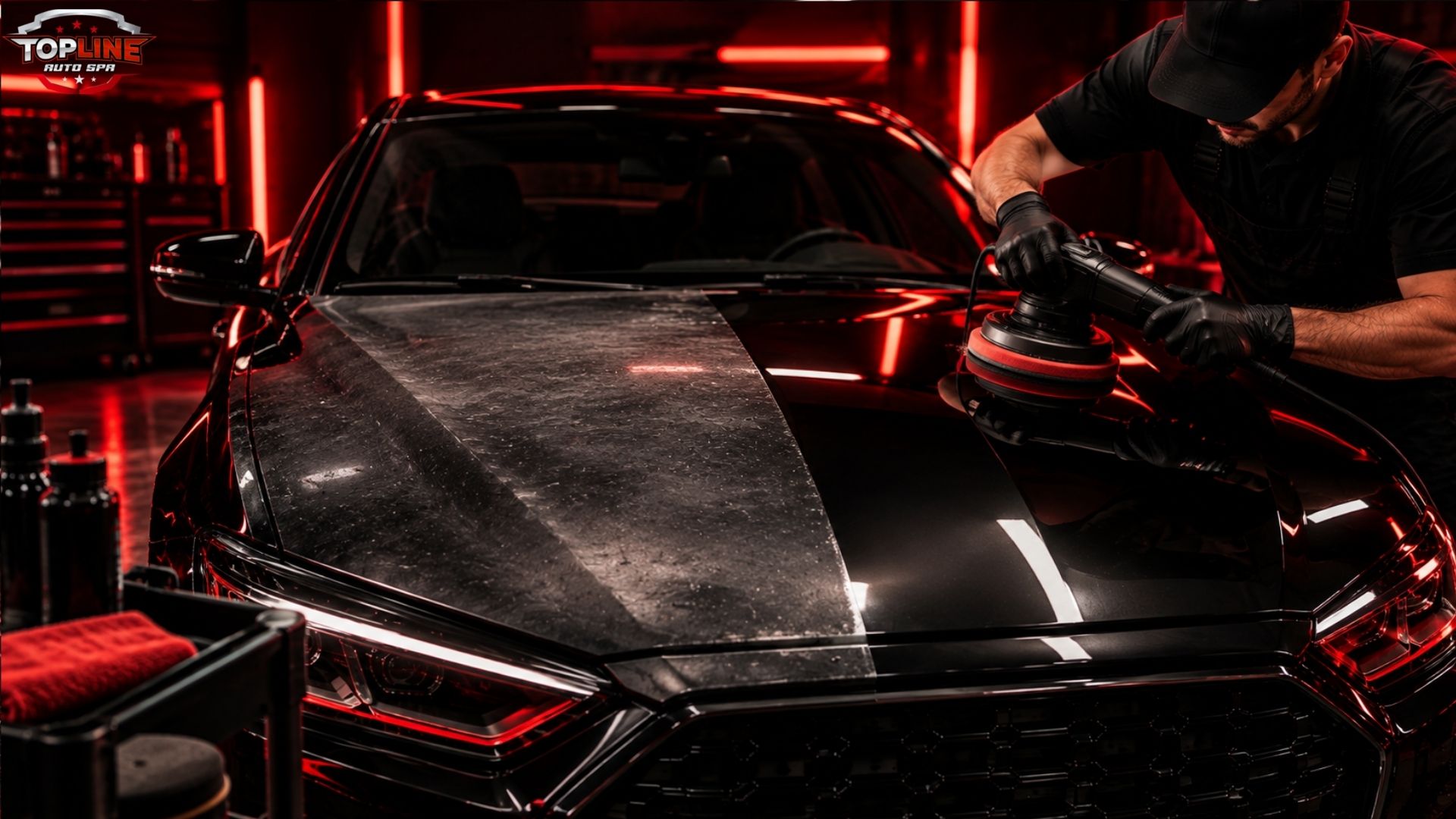
Machine polishing removes a microscopic layer of clear coat to reveal fresher paint beneath and restore gloss.
This is where DIY becomes more technical. Machine polishers are powerful tools that can cause damage if used incorrectly, including creating swirl marks or burning through your clear coat.
Equipment needed:
- Dual-action polisher (the safest option for DIY use)
- Foam pads (cutting pads for heavy oxidation, finishing pads for light restoration)
- Polishing compound or cutting compound
- Microfiber towels for buffing residue
- Masking tape for trim and lights
- Dust mask and eye protection
- Extension cord and power supply
Basic machine polishing process:
- Mask off trim, lights, and badges to prevent damage
- Apply cutting compound or polish to the foam pad
- Start with low speed to spread the product
- Increase speed gradually as you work
- Use overlapping passes in straight lines or gentle circles
- Apply moderate pressure; the machine does the work
- Buff residue with microfiber towels between sections
- Repeat with finishing compound for a final shine
Important caution: Machine polishing removes clear coat. Aggressive polishing on panels that are already thin can expose the base coat or primer. Start gently, and if you’re uncomfortable, professional detailing is a safer choice.
Results: Machine polishing can restore significant paint fade, returning gloss and clarity. Results typically last 3-6 months before fading resumes unless you apply protective coatings.
Method 3: Compound and Wax Treatment
This is the most accessible DIY method, though results are less dramatic than machine polishing.
Rubbing compound is less aggressive than machine polish. It contains mild abrasives that remove oxidation through manual application.
DIY compound and wax process:
- Wash and dry your vehicle completely
- Apply rubbing compound to a microfiber applicator pad
- Work in small sections, rubbing in circular motions
- Use moderate pressure; you control the intensity
- Wipe away residue with a clean microfiber towel
- Repeat across the entire vehicle
- Once compound is complete, apply quality car wax
- Wax application: thin, even coats, buffed to a shine
Timeline: Hand application takes 3-4 hours for a full vehicle.
Results: Compound and wax can improve mild to moderate fade. The improvement is visible but less dramatic than machine polishing. The wax provides some UV protection, slowing future fade.
Professional Paint Restoration: When and Why
While DIY methods work for mild fade, professional restoration delivers superior results for moderate to severe fade.
Professional Paint Correction
Professional paint correction goes beyond polishing. It’s a multi-step process that removes damaged clear coat layers, corrects imperfections, and restores depth to your paint.
Professional detailers use industrial-grade equipment, techniques, and compounds unavailable to consumers. They can safely remove multiple clear coat layers without risk of base coat exposure.
The process includes:
- Paint depth measurement to determine safe removal parameters
- Aggressive cutting compounds to remove maximum oxidation
- Progressive polishing with increasingly fine compounds
- Finishing with nano-polishes for maximum clarity
- Paint inspection under specialized lighting to ensure quality
Professional paint correction can transform severely faded paint, returning it to near-original condition. Results last longer than DIY methods, typically 6-12 months or longer depending on maintenance.
When Professional Correction Is Worth It
Consider professional paint restoration if you have:
- Severe fade across multiple panels
- Fading that DIY methods haven’t adequately addressed
- Preparation for vehicle sale or lease return
- High-end or luxury vehicles where appearance significantly impacts value
- Existing swirl marks or light scratches requiring correction
- Vehicles regularly exposed to intense UV or harsh weather
For Lehigh Valley residents, TopLine Auto Spa offers professional paint restoration services from their Allentown location, with expertise in restoring vehicles damaged by Pennsylvania’s challenging climate.
Long-Term Paint Protection After Restoration
Restoring faded paint is only half the battle. Preventing future fade through protective coatings is crucial for maintaining results.
The Role of Protective Coatings
After restoration, your paint is vulnerable again. Without protection, the fade cycle restarts immediately.
Three primary options exist:
Traditional Car Wax: Creates a temporary barrier (3-6 months) that reduces UV penetration. Requires frequent reapplication but is affordable and easy.
Ceramic Coating: A semi-permanent protective layer (6-24 months) that bonds to your clear coat. Provides superior UV protection and hydrophobic properties. Costs more than wax but lasts significantly longer and requires less maintenance.
Paint Protection Film (PPF): A physical barrier protecting against UV, contaminants, and minor impacts. Lasts 10+ years. Best applied to high-impact areas (hood, fenders, door handles) or as complete vehicle coverage.
Ceramic Coating for Paint Preservation
For vehicles in Pennsylvania’s harsh climate, ceramic coating is an excellent investment after paint restoration.
Ceramic coatings contain nanotechnology that creates a microscopic glass-like layer across your paint. This layer:
- Blocks UV radiation, preventing oxidation
- Repels water and contaminants
- Makes washing easier and less likely to cause swirl marks
- Enhances paint gloss and depth
- Provides protection for 12-24 months with proper maintenance
Applied professionally, ceramic coatings cost $500-$2,000 depending on vehicle size and product grade. This is substantially cheaper than professional paint correction repeated every 6 months.
Complete Paint Restoration Workflow for Best Results
If you’re serious about truly restoring faded paint and maintaining results, here’s the optimal sequence:
Step 1: Professional Assessment
Have a professional detailer assess your paint condition. They can measure clear coat thickness, identify problem areas, and recommend appropriate restoration level.
Step 2: Comprehensive Vehicle Detailing
Before any restoration work, your vehicle needs thorough exterior detailing to remove all surface contaminants. Dirt, tar, tree sap, and brake dust interfere with restoration compounds and prevent proper assessment of paint condition.
Professional detailing includes:
- Pressure washing to remove loose dirt
- Clay bar treatment for embedded contaminants
- Degreasing to remove tar and adhesive residue
- Paint inspection under bright lighting
- Documentation of paint condition before restoration
This step ensures restoration work is done on clean, properly prepared surfaces.
Step 3: Paint Correction
Based on fade severity, professional paint correction removes oxidized clear coat and restores gloss.
Step 4: Paint Protection Application
After correction, immediately apply protective coating to prevent renewed fade.
Step 5: Interior and Additional Services
While your paint is being restored, address interior protection and other services that enhance overall vehicle condition and value.
Maintenance Plan for Protecting Restored Paint
Restoration isn’t one-time maintenance; it’s the beginning of a protection strategy.
Monthly Maintenance
- Wash your vehicle every 2-4 weeks with pH-balanced car wash soap
- Dry completely after washing
- Avoid automatic car washes with brushes (use touchless or hand washing)
- Park in shade when possible to minimize UV exposure
Quarterly Maintenance
- Reapply car wax every 3 months if you’re not using ceramic coating
- Inspect for contaminants and apply clay bar treatment if needed
- Check for any new swirl marks or scratches requiring touch-up
Annual Maintenance
- Deep cleaning and decontamination
- Paint inspection under bright lighting
- Touch-up of any areas showing new damage
- Professional wash and wax service
- Consideration of ceramic coating renewal if it’s been 12-18 months
Seasonal Considerations for Pennsylvania Drivers
Winter: Road salt is your paint’s worst enemy. Wash your vehicle weekly during winter months to remove salt before it causes permanent damage.
Spring: Winter damage becomes visible. Schedule professional detailing to assess and address any salt damage to paint.
Summer: UV protection is critical. Ensure ceramic coating or wax is current. Park in shade when possible.
Fall: Prepare for winter by ensuring paint protection is fresh and effective.
Cost Comparison: DIY vs. Professional Restoration
Understanding the cost implications helps you make the right choice:
DIY Clay Bar and Compound Treatment
- Materials: $30-$80
- Time: 4-6 hours
- Results: Improvement in mild to moderate fade
- Durability: 2-4 months before fading resumes
DIY Machine Polishing
- Equipment investment: $100-$300 (if you don’t own equipment already)
- Materials: $40-$100
- Time: 6-8 hours
- Results: Significant improvement in moderate fade
- Durability: 3-6 months
Professional Paint Correction
- Cost: $500-$2,500 depending on severity and vehicle size
- Time: 4-8 hours professional work, you don’t participate
- Results: Dramatic restoration of even severe fade
- Durability: 6-12 months before fading resumes
Paint Correction Plus Ceramic Coating
- Cost: $1,200-$3,500 total
- Time: Professional work spread across 1-2 days
- Results: Severe fade elimination plus ongoing protection
- Durability: Coating protection for 12-24 months
Over a 3-year period, investing in professional restoration with ceramic coating often costs less than repeated DIY methods plus eventual professional correction when DIY approaches fail to deliver adequate results.
When to Call the Professionals
Contact professional detailers if you experience:
- Severe fading that makes the vehicle look significantly aged
- Fading that DIY methods haven’t adequately addressed
- Swirl marks and light scratches requiring correction
- Fading concentrated on exposed areas (hood, roof, trunk)
- Preparation for sale, lease return, or trade-in
- High-value vehicles where appearance directly impacts worth
- Uncertainty about whether your clear coat can handle machine polishing
For Lehigh Valley residents, TopLine Auto Spa in Allentown specializes in paint restoration for vehicles damaged by Pennsylvania’s harsh climate. Their professional team has experience with local conditions and can recommend the ideal restoration approach for your specific vehicle.
Conclusion: Your Comprehensive Paint Restoration Plan
Faded car paint doesn’t have to be permanent. Whether you choose DIY restoration for mild fade or professional paint correction for severe deterioration, you have options.
The key is taking action before fade becomes severe. Regular washing, protective coatings, and parking habits slow the process significantly. When fade does occur, address it promptly rather than waiting until damage becomes extreme.
For Lehigh Valley vehicle owners, the challenging Pennsylvania climate means paint protection isn’t optional if you want to maintain your vehicle’s appearance and value. Professional detailing services provide expertise and products that DIY methods can’t match, especially for severely faded paint.
Ready to restore your vehicle’s shine? Book Now with TopLine Auto Spa to discuss professional paint restoration options. Our Allentown-based team understands the specific challenges Pennsylvania vehicles face and can recommend the ideal restoration approach for your car’s condition and your goals.
FAQ: Common Questions About Paint Fade and Restoration
Q1: Can faded car paint be permanently restored?
No restoration is permanent without ongoing protection. Faded paint can be professionally restored to near-original condition, but UV exposure will eventually cause new fading. However, applying protective coatings after restoration significantly extends results. With ceramic coating or PPF, you can maintain restored paint appearance for 12-24 months or longer.
Q2: How long does professional paint correction last?
Professional paint correction results typically last 6-12 months depending on environmental exposure and maintenance. Vehicles in harsh climates with intense UV or frequent salt exposure may see results fade faster. Applying ceramic coating immediately after correction extends durability to 18-24 months.
Q3: Is it safe to use a machine polisher on my own car?
Machine polishers can be used safely with proper technique and equipment. Dual-action polishers are more forgiving than rotary polishers. However, incorrect technique can cause swirl marks, holograms, or clear coat damage. If you’re uncomfortable, professional detailing is safer for valuable vehicles.
Q4: What’s the difference between car wax and ceramic coating?
Car wax is a temporary coating lasting 3-6 months that sits on top of your clear coat. Ceramic coating is semi-permanent (12-24 months) and chemically bonds to your clear coat. Ceramic coating provides superior UV protection, water beading, and durability, though it costs more than wax.
Q5: Does my vehicle need paint correction before ceramic coating?
Ideally, yes. Ceramic coating seals existing imperfections into your paint. If you have swirl marks, light scratches, or oxidation, these become locked in under the coating. Professional paint correction followed by ceramic coating provides the best results.
Q6: How much does professional paint correction cost?
Professional paint correction typically costs $500-$2,500 depending on fade severity, vehicle size, and local market rates. Single-stage correction for mild fade might cost $500-$800. Multi-stage correction for severe fade could reach $2,000-$2,500. Getting quotes from local detailers provides accurate pricing for your specific vehicle.
Q7: Can paint fade be prevented entirely?
Complete prevention isn’t possible, but you can significantly slow the process. Regular washing, parking in shade, applying protective coatings (wax or ceramic coating), and using windshield sunshades all reduce fade rate. Vehicles garaged most of the time experience much slower fade than outdoor-parked vehicles.
Q8: Is paint fade covered by car insurance?
No. Paint fade from sun exposure and environmental damage is considered normal wear and tear, not a covered loss. Comprehensive insurance covers sudden damage like hail or accidents, not gradual deterioration.
Q9: Can I apply ceramic coating myself?
Professional-grade ceramic coatings can be applied at home with proper preparation and technique. However, improper application can result in cloudy appearance, uneven coverage, or failure to bond correctly. Professional application ensures proper surface preparation and even application, making it worthwhile for expensive vehicles.
Q10: How does Pennsylvania’s climate affect paint fade?
Pennsylvania’s four distinct seasons intensify paint damage. Winter salt exposure causes oxidation. Spring humidity and temperature fluctuations stress the paint. Summer UV is intense. Fall temperature swings continue the cycle. Lehigh Valley residents should expect paint fade to progress faster than in more stable climates, making regular protection and maintenance especially important.