
That persistent smoke smell lingering in your car is more than just unpleasant. It’s embarrassing when passengers wrinkle their noses. It affects your vehicle’s resale value. It permeates your clothes and belongings. And worst of all, it seems impossible to eliminate no matter what you try.
Whether the smoke came from previous owners, passengers, or was trapped during years of exposure to secondhand smoke, getting that smell out of your car requires understanding where it hides and how to systematically target every surface and crevice where odor molecules embed themselves.
The good news: smoke smell is removable. You have multiple proven methods ranging from simple DIY solutions to professional treatments. This comprehensive guide walks you through every technique, from budget-friendly options to professional-grade interventions that guarantee results.
Understanding Smoke Smell in Cars: Why It’s So Persistent
Before tackling removal, you need to understand why smoke smell is so stubborn and where it actually lives in your vehicle.
The Science of Smoke Odor
Smoke smell isn’t just unpleasant air hanging around. Smoke consists of thousands of microscopic particles and chemical compounds that settle on every surface inside your vehicle: upholstery, carpeting, headliner, plastic trim, leather, and even the air conditioning system.
These particles and odor-causing molecules bond to surfaces at a molecular level. When you sit in the car or run the air conditioning, the odor reactivates. This is why simply opening windows or using air fresheners provides only temporary relief. You’re not addressing the root cause; you’re masking a symptom.
The worse the smoke exposure, the deeper the odor penetration. A car that smelled of smoke for a few months versus years will have dramatically different odor saturation levels requiring different intervention strategies.
Where Smoke Smell Hides in Your Car
Smoke doesn’t distribute evenly throughout your vehicle. It concentrates in specific areas:
Fabric surfaces: Seats, carpeting, floor mats, and headliner absorb and retain odor molecules like a sponge. Cloth seats are particularly problematic because the fibers trap smoke deep within their structure.
Air conditioning system: Every time you run your AC, air passes through the evaporator and cabin air filter. Smoke smell embeds in these components, and your AC system recycles the odor back into the cabin every time you drive.
Plastic and trim: Hard surfaces like dashboards, door panels, and steering wheels accumulate smoke residue. While less absorbent than fabric, these surfaces still trap odor-causing compounds.
Door seals and weatherstripping: Rubber seals and weatherstripping trap smoke particles. Every time you open and close doors, odor particles are disturbed and reactivated.
Ventilation ducts: Air ducts running throughout your vehicle can accumulate smoke particles, spreading odor throughout the cabin.
Leather seats: If your car has leather, smoke penetrates the pores of the material and requires specific treatment approaches.
The severity of smoke smell depends on how much of each surface area is affected and how deeply smoke has penetrated.
DIY Methods for Removing Smoke Smell from Your Car
Starting with DIY approaches makes sense for mild to moderate smoke smell. These methods tackle specific problem areas and, used together, can significantly reduce odor.
Method 1: Thorough Vacuuming and Fabric Cleaning
Your first step is removing loose smoke particles and residue from fabric surfaces.
What you’ll need:
- Vacuum cleaner with upholstery attachment (a shop vac or carpet cleaner works even better)
- Stiff-bristled brush for agitation
- Fabric cleaner or combination of vinegar and water
- Spray bottles
- Microfiber towels
- Steam cleaner (optional but highly effective)
Step-by-step process:
- Remove floor mats from your car and vacuum them separately or replace them entirely
- Vacuum all seats thoroughly, using the crevice attachment to reach between seat cushions
- Vacuum the entire floor, underneath the seats, and under the dashboard where particles accumulate
- Vacuum the headliner using an upholstery attachment
- For stubborn odor, spray fabric surfaces lightly with a mixture of equal parts white vinegar and water
- Let the solution sit for 15-20 minutes to break down odor molecules
- Vacuum again to remove the vinegar solution
- If available, use a steam cleaner on seats and carpets; the heat helps break down odor compounds
Vinegar works because its acidic nature neutralizes alkaline odor compounds. The smell of vinegar dissipates within hours as it evaporates.
Timeline: 2-3 hours for a complete vehicle
Results: Vacuum and fabric cleaning addresses surface-level and moderate smoke smell. For mild smoke odor, this method alone often delivers satisfactory results. For heavy smoking, additional methods are necessary.
Method 2: Baking Soda Treatment
Baking soda is one of the most effective odor-neutralizing substances available, and it’s inexpensive.
How baking soda works:
Baking soda (sodium bicarbonate) is alkaline and neutralizes acidic odor compounds through chemical reaction. Unlike air fresheners that mask smell, baking soda actually eliminates odor.
Baking soda application:
- Sprinkle baking soda generously over all seats, carpeting, floor mats, and areas where smoke smell is strongest
- Work the baking soda into fabric using a stiff brush, making sure it penetrates deeply
- Leave baking soda sitting for 24-48 hours (longer is better)
- Vacuum thoroughly to remove all baking soda
- Repeat if necessary; multiple treatments often work better than single application
Enhanced baking soda method:
For more stubborn odors, create a baking soda paste:
- Mix baking soda with a small amount of water to create a thick paste
- Apply paste to problem areas (usually seat crevices and floor areas)
- Let sit for 24 hours
- Vacuum and wipe clean with damp cloth
Timeline: Active work time is minimal, but wait time is 24-48 hours
Results: Baking soda is highly effective for moderate smoke smell. Combined with vacuuming and fabric cleaning, it eliminates many cases of residual smoke odor.
Method 3: Activated Charcoal Treatment
Activated charcoal is porous and absorbs odor molecules through adsorption (different from absorption).
Application:
Activated charcoal products come in various forms: bags, canisters, and porous blocks. The method is simple:
- Place activated charcoal bags throughout your vehicle (under seats, in cup holders, trunk)
- Close windows and doors to allow charcoal to work
- Leave charcoal in place for 24-48 hours initially
- Remove charcoal and evaluate odor level
- Repeat with fresh charcoal if needed
- For ongoing odor control, leave a charcoal bag permanently in your vehicle
Timeline: Minimal active work, 24-48 hours waiting time
Cost: $20-$50 for quality activated charcoal products
Results: Activated charcoal is effective for mild to moderate smoke smell and works well as ongoing odor management. It’s less aggressive than baking soda but provides good results with minimal effort.
Method 4: Air Conditioning System Cleaning
Smoke smell often originates from or is recirculated through your air conditioning system.
Cabin air filter replacement:
The simplest approach is replacing your cabin air filter:
- Locate your vehicle’s cabin air filter (usually behind the glove compartment or under the hood)
- Remove the old filter
- Install a new, high-quality cabin air filter
- Run your AC on maximum setting for 10-15 minutes to distribute fresh air
A fresh cabin air filter removes particulates and can improve odor significantly.
AC coil and vent cleaning:
For more thorough AC system cleaning:
- Purchase AC coil cleaner (available at auto parts stores)
- With the car running and AC on recirculation mode, spray the cleaner into the cabin air intake (usually located near the windshield base)
- Let the AC run for several minutes to distribute cleaner
- The cleaner coats the evaporator coil and kills odor-causing bacteria and mold
- Some products require waiting 30 minutes before running AC
Professional AC system cleaning:
For heavily contaminated systems, professional shops can access and clean AC components directly, which is more effective than DIY approaches.
Results: AC system cleaning addresses odor originating from or recirculated through your air conditioning, often providing dramatic improvement in overall cabin odor.
Method 5: Odor-Eliminating Products
Several commercial products specifically target smoke smell. These work through various mechanisms:
Enzyme-based odor eliminator:
Enzymes break down odor-causing organic compounds. Products like Nature’s Miracle or similar enzyme cleaners work well on fabric surfaces.
Application:
- Spray enzyme product on affected surfaces
- Let sit according to product instructions (usually 30 minutes to several hours)
- Vacuum or rinse per instructions
Ozone generators:
Ozone machines create ozone gas that oxidizes and destroys odor molecules. They’re highly effective but require the vehicle to be unoccupied during treatment (ozone is toxic at high concentrations).
Professional ozone treatments typically cost $150-$300 but are very effective for stubborn smoke smell.
Carbon filters and air purifiers:
Portable car air purifiers with carbon filters can be placed in your vehicle to continuously filter odor. They’re ongoing solutions rather than treatments.
Results: Product effectiveness varies. Enzyme-based cleaners work well for moderate smell. Ozone treatment is one of the most effective solutions short of professional detailing.
When DIY Methods Aren’t Enough: Professional Smoke Odor Removal
For severe smoke smell or when DIY methods have failed to deliver adequate results, professional interventions become necessary.
Professional Interior Detailing for Smoke Odor
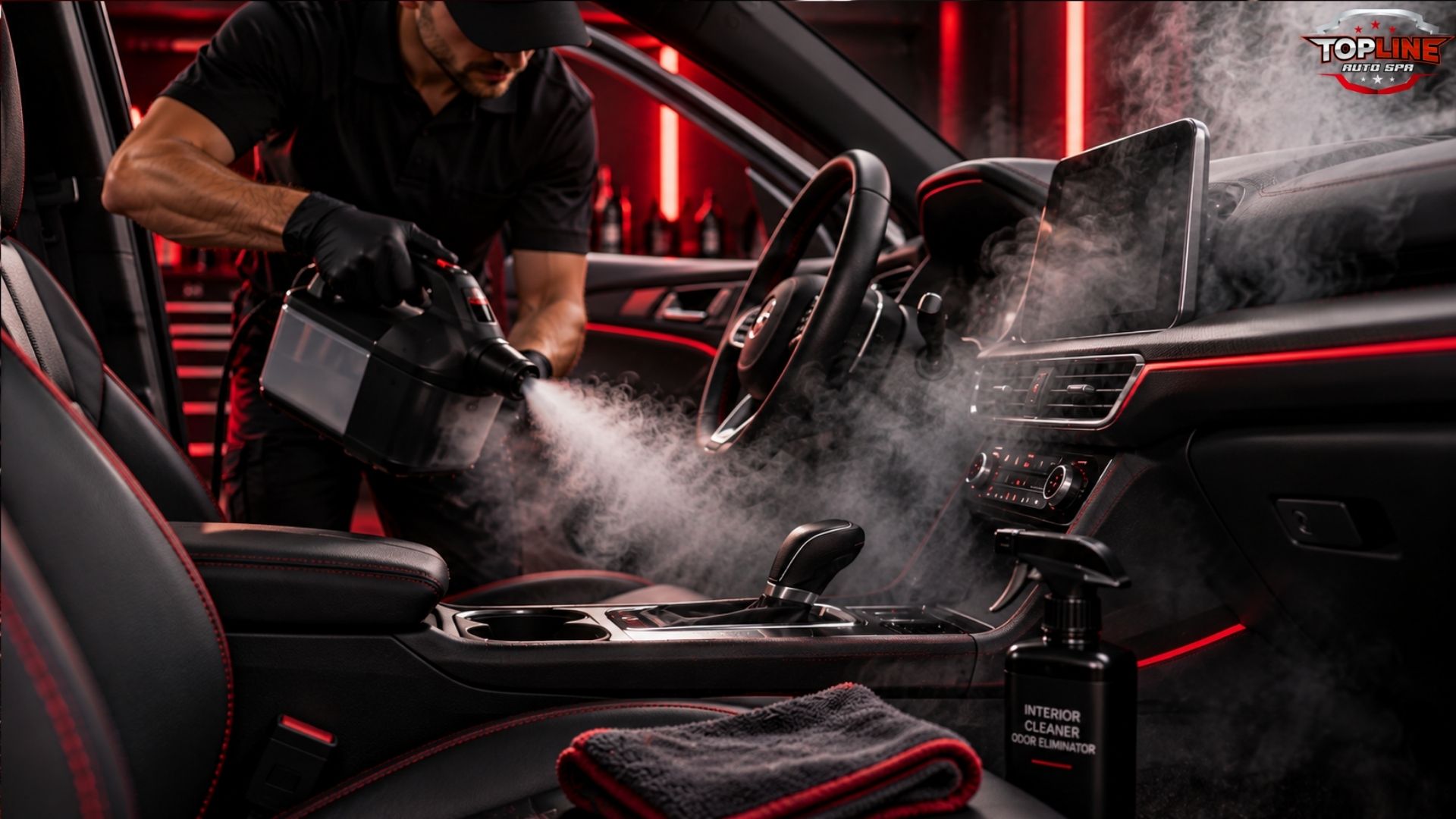
Professional interior detailing goes far beyond what DIY methods can achieve. Professional detailers have access to commercial-grade equipment, specialized cleaning solutions, and techniques developed specifically for smoke odor elimination.
What professional detailing includes:
- Industrial-strength vacuuming with HEPA filtration
- Steam cleaning of all fabric surfaces with heated extraction
- Professional-grade fabric and leather cleaning products
- Deep cleaning of air conditioning system and vents
- Cleaning of all hard surfaces and crevices
- Treatment of door seals and weatherstripping
- Professional ozone or hydroxyl radical treatment
- Application of odor-neutralizing enzymes at the molecular level
Professional detailers can access areas DIY methods cannot reach, like behind dashboard panels, inside air ducts, and deep within seat structures.
Cost: $300-$800 depending on vehicle size and smoke severity
Results: Professional detailing eliminates most smoke smell, even severe cases. Results are typically permanent or long-lasting.
Ozone Treatment for Severe Smoke Smell
Ozone generators are professional-level equipment that create ozone gas, which oxidizes and destroys odor molecules at a molecular level.
How ozone treatment works:
- All windows and doors are sealed
- Ozone generator runs for 30-60 minutes, filling the vehicle with ozone gas
- Vehicle sits sealed for an additional 30-60 minutes allowing ozone to work
- Vehicle is aired out thoroughly before use (ozone dissipates quickly)
- Process may be repeated for severe odors
Ozone safety:
Ozone is toxic to humans and pets at high concentrations. Treatment must be done by professionals with proper safety protocols. The vehicle must be thoroughly aired out before anyone enters.
Cost: $150-$400 for professional ozone treatment
Results: Ozone treatment is one of the most effective methods available, often eliminating even severe smoke smell in a single treatment.
Interior Protection After Odor Removal
After successfully removing smoke smell, preventing its return or recurrence of odor buildup is important.
Professional interior protection treatments create protective barriers on fabric and surfaces that repel odors and make future cleaning easier.
Protection options:
- Fabric protection coating: Creates water and odor-resistant barrier on upholstery
- Leather protection: Conditions leather while creating protective layer
- Interior ceramic coating: Nanotechnology coating protecting all interior surfaces
- Odor-resistant treatments: Products that neutralize odor molecules before they bond to surfaces
These treatments typically cost $150-$400 but provide months or years of protection against odor accumulation.
Preventing Smoke Smell in Your Car
Once you’ve successfully removed smoke smell, taking steps to prevent it from returning is important.
Maintenance Habits
Regular vacuuming: Vacuum your car weekly to remove dust and contaminants before they accumulate.
Wipe hard surfaces: Use microfiber cloths to wipe down interior surfaces regularly, removing dust and potential odor-causing buildup.
Air conditioning maintenance: Change your cabin air filter every 12-15 months. Run your AC monthly even in winter to keep the system active.
Leave windows cracked: When parked for extended periods, slightly cracking windows allows air circulation and prevents stale air accumulation.
Avoid eating in your vehicle: Food particles and spills attract bacteria that create odors.
Protective Measures
Seat covers: Protective seat covers prevent odor absorption into upholstery if you’re concerned about smoke or other odor sources.
Floor mats: Quality floor mats protect carpeting and can be easily removed and cleaned.
Air fresheners: While not true odor eliminators, quality air fresheners help maintain fresh-smelling cabin, especially after professional treatment.
Sunshades: Blocking sunlight reduces temperature and helps prevent odor reactivation from heat.
Comparison: DIY vs. Professional Smoke Odor Removal
Understanding the trade-offs helps you choose the right approach:
DIY Approach
- Cost: $50-$200 for materials
- Time investment: 20-30 hours across multiple treatments
- Effectiveness for mild smell: 70-90%
- Effectiveness for moderate smell: 40-70%
- Effectiveness for severe smell: 10-30%
- Duration: Results last 3-6 months if smell was mild
Professional Detailing
- Cost: $400-$1,000
- Time investment: 4-8 hours (you don’t participate)
- Effectiveness for mild smell: 95%+
- Effectiveness for moderate smell: 90-95%
- Effectiveness for severe smell: 80-95%
- Duration: Results often permanent or last 12+ months
Ozone Treatment
- Cost: $200-$400
- Time investment: 2-3 hours
- Effectiveness for mild smell: 99%
- Effectiveness for moderate smell: 95%+
- Effectiveness for severe smell: 85-95%
- Duration: Results typically permanent
Over time, investing in professional treatment once often costs less than repeated DIY attempts that may not fully resolve the problem.
Smoke Smell Removal Timeline: Realistic Expectations
Different levels of smoke smell require different timelines to resolve:
Mild smoke smell (recent, light exposure):
- DIY approach: 1-2 weeks to eliminate
- Professional approach: 1-2 days
Moderate smoke smell (several months exposure):
- DIY approach: 4-8 weeks with multiple treatments
- Professional approach: 1-3 days
Severe smoke smell (years of heavy smoking):
- DIY approach: May not be fully resolvable
- Professional approach: 1-2 visits, 3-7 days total
The timeline depends on your patience for multiple treatments and willingness to invest in professional services. Professional solutions deliver faster, more reliable results.
Conclusion: Taking Action Against Car Smoke Smell
Smoke smell in your car is genuinely resolvable. You have multiple proven methods ranging from inexpensive DIY approaches to professional treatments that guarantee results.
For mild smoke smell, start with DIY methods: vacuuming, baking soda treatment, and activated charcoal. These cost minimal money and work effectively for light odor issues. You can progress to more aggressive methods if initial attempts don’t deliver satisfactory results.
For moderate to severe smoke smell, or if DIY methods have failed, professional intervention saves time and delivers superior results. Professional detailing combined with ozone treatment eliminates even the most stubborn smoke odor, often permanently.
The key is starting now. Smoke smell doesn’t resolve on its own; it requires active intervention. The longer you wait, the deeper odor molecules embed into your vehicle’s surfaces, making removal progressively harder.
For Allentown and Lehigh Valley residents who’ve tried everything without success, professional detailing services can provide the expertise and equipment needed to permanently eliminate smoke smell. Book Now to discuss your specific situation and get a professional odor assessment. Our team will recommend the most effective approach for your vehicle’s condition and budget.
FAQ: Common Questions About Smoke Smell Removal
Q1: How long does it take to completely remove smoke smell from a car?
Timeline varies based on smoke exposure severity and removal method used. Mild smoke smell can be resolved in 1-2 weeks with DIY methods. Moderate smell typically requires 4-8 weeks of consistent DIY treatment or 2-3 days of professional work. Severe smoke smell may require professional intervention and takes 1-2 weeks to fully resolve, even with professional treatment.
Q2: Does ozone treatment actually work for smoke smell?
Yes, ozone treatment is one of the most effective methods available. Ozone gas oxidizes and destroys odor molecules at a molecular level. Professional ozone treatment eliminates 85-99% of smoke smell depending on severity, often in a single treatment. However, ozone is toxic to humans and pets, so only trained professionals should perform treatment.
Q3: Will baking soda get rid of smoke smell completely?
Baking soda is highly effective for mild to moderate smoke smell, especially when combined with other methods like vacuuming and fabric cleaning. For severe smoke smell, baking soda alone may not be sufficient. Multiple applications of baking soda (leaving it sitting for 24-48 hours repeatedly) increase effectiveness. Baking soda works best as part of a comprehensive odor removal strategy rather than as a standalone solution.
Q4: Can air fresheners eliminate smoke smell?
No. Air fresheners only mask smoke smell temporarily. They cover the odor with a different scent but don’t eliminate the underlying smoke compounds embedded in your car’s surfaces. Once the air freshener’s scent fades, the smoke smell returns. True odor elimination requires methods that break down or neutralize odor molecules, like baking soda, professional detailing, or ozone treatment.
Q5: Does replacing the cabin air filter remove smoke smell?
Replacing the cabin air filter is a good first step and may provide some odor improvement, especially if your air conditioning is recirculating smoke smell. However, cabin air filter replacement alone rarely eliminates smoke smell completely. It’s most effective when combined with other methods like fabric cleaning and odor-neutralizing treatments.
Q6: How much does professional smoke odor removal cost?
Professional detailing for smoke odor typically costs $300-$800 depending on vehicle size and smoke severity. Ozone treatment adds $150-$400. For severe cases requiring both detailing and ozone treatment, total cost ranges from $500-$1,200. This is often less than the cost of repeated failed DIY attempts followed by eventual professional intervention.
Q7: Can I remove smoke smell if my car has leather seats?
Yes, but leather requires different treatment than cloth. Leather is less absorbent than cloth, making smoke smell less deeply embedded. Professional leather cleaning and conditioning treatment can eliminate smoke smell from leather seats. Avoid vinegar solutions on leather; use leather-specific cleaners. Professional detailing is recommended for valuable leather interiors.
Q8: Will smoking outside my car but near it cause interior smell?
Yes, smoke can enter your vehicle through open windows and air intakes. Even with windows closed, smoke odor molecules can penetrate if they’re concentrated enough outside. If you smoke near your parked car, some odor transfer is likely. Keeping windows fully closed and air conditioning on recirculation mode minimizes this effect.
Q9: Is smoke smell damage permanent if left untreated?
Smoke smell doesn’t cause permanent damage to your car’s components or structure, but odor molecules continue embedding deeper into surfaces the longer they’re present. After years of smoke exposure, odor penetration becomes more extensive and harder to eliminate completely. Earlier treatment is always easier and more successful than delayed treatment. However, even severe smoke smell can be removed with professional methods; it’s never truly permanent.
Q10: How can I prevent smoke smell if I buy a used car that previously had smokers?
Start immediately with comprehensive cleaning: professional detailing, new cabin air filter, and AC system cleaning. Consider ozone treatment if smoke smell is noticeable. Apply interior protection treatments to prevent future odor absorption. Maintain regular vacuuming and surface cleaning. Never allow smoking in your vehicle going forward. These steps prevent smoke smell recurrence and keep your car fresh-smelling long-term.