
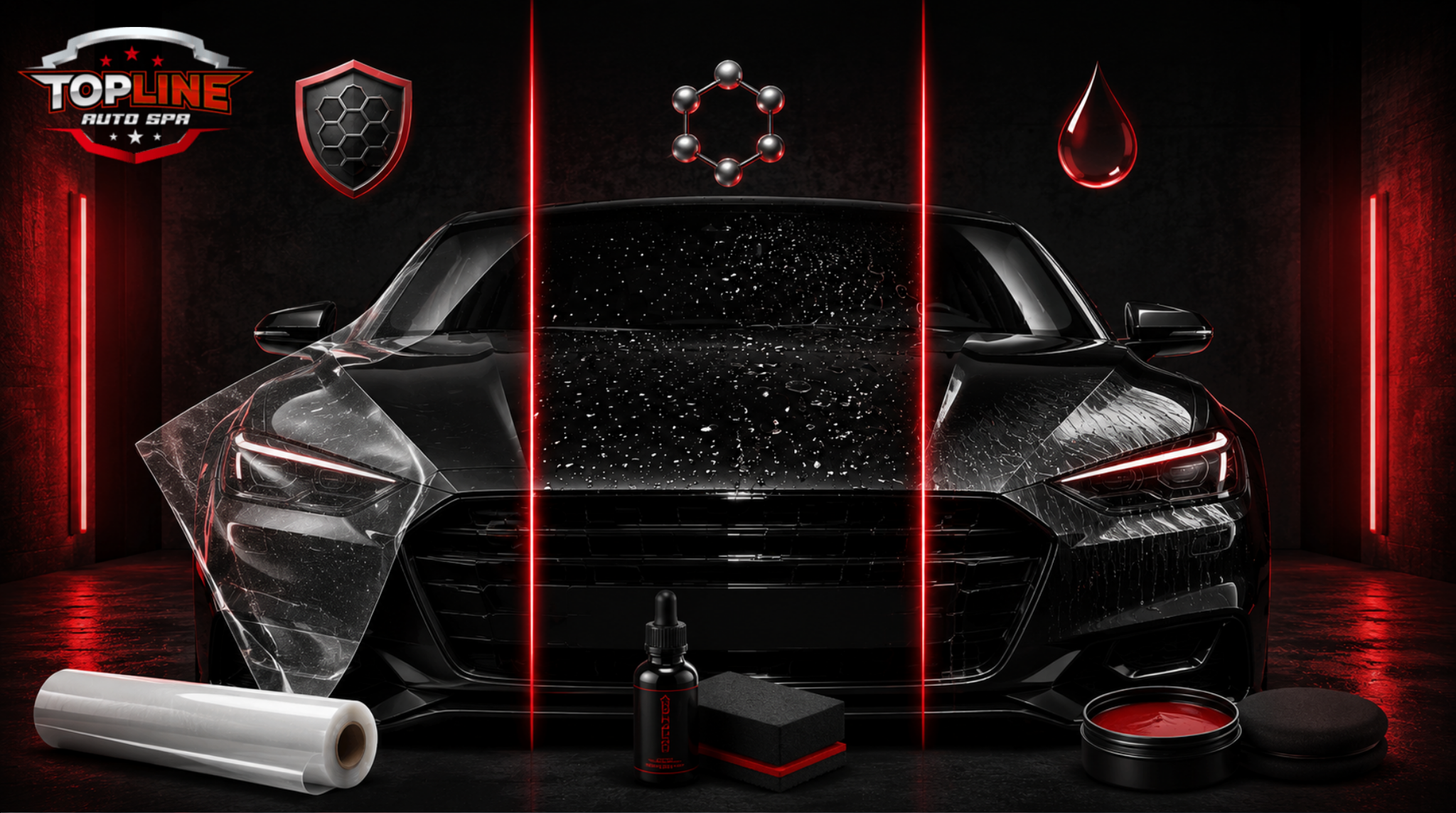
Protecting your car’s paint isn’t just about keeping it shiny; it’s a financial decision. Every rock chip, swirl mark, and sun-faded panel chips away at your vehicle’s resale value. If you want to shield your investment, you generally have three choices: Paint Protection Film (PPF), ceramic coatings, or traditional wax.
But which one actually gives you the best return on investment (ROI)?
While one option costs pocket change up front, it requires constant manual labor. Another requires a significant upfront investment but can preserve thousands in vehicle value for a decade. Let’s break down the real-world costs, lifespan, and value retention of each method so you can choose the best protection for your budget and driving habits.
Key Takeaways
- Best for Impact Protection: PPF is the only option that physically stops rock chips, scratches, and road debris.
- Best for Low-Maintenance Gloss: Ceramic coatings eliminate the need for waxing, repel water, and keep your car cleaner for years.
- Best for Ultra-Short-Term Budgets: Wax provides cheap, short-term shine but offers zero defense against rock chips and breaks down in months.
- The High-Value Choice: Combining PPF on high-impact areas (front bumper, hood) with a ceramic coating on the rest of the body yields the highest overall aesthetic and financial ROI.
The Contenders: Side-by-Side Comparison
To calculate your return, you first need to understand what you are paying for. Each product serves a distinct purpose and offers varying levels of defense.
| Feature | Paint Protection Film (PPF) | Ceramic Coating | Traditional Wax |
| Primary Benefit | Physical barrier against chips & scratches | Chemical barrier against UV, stains, & dirt | Temporary shine & light UV protection |
| Average Lifespan | 7 to 10 years | 2 to 5+ years | 1 to 3 months |
| Upfront Cost | Moderate to High | Moderate | Very Low |
| Maintenance Required | Low (Regular washing) | Low (Easy washing, annual top-up) | High (Reapply 4-6 times a year) |
| Resale Value Impact | Highest (Prevents physical damage) | High (Preserves factory paint depth) | Minimal / Temporary |
Paint Protection Film (PPF)
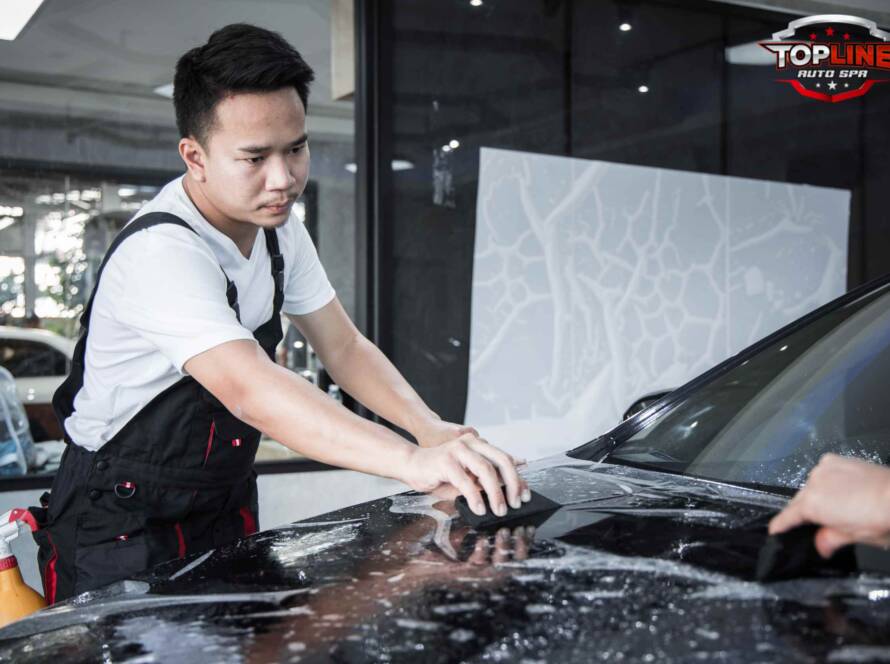
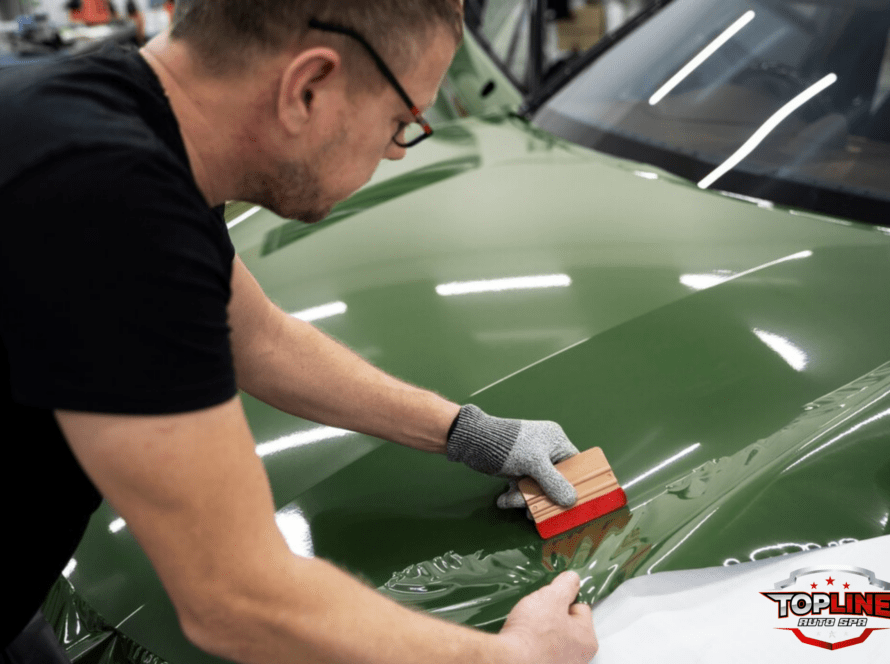
Often called a “clear bra,” PPF is a thick, polyurethane film applied directly to the vehicle’s panels. It features self-healing properties, meaning minor swirls disappear when exposed to heat. Because it physically absorbs impacts, investing in professional paint protection film services is the most effective way to prevent costly paint touch-ups down the road.
Ceramic Coating
A ceramic coating is a liquid polymer that chemically bonds with your vehicle’s factory paint. Instead of absorbing rocks, it creates a hydrophobic (water-repelling) layer that blocks UV rays, bird droppings, and chemical stains. Opting for premium ceramic coating services dramatically simplifies washing your car and keeps it looking detailed for years without fading.
Automotive Wax
Wax sits loosely on top of the paint, offering a brief layer of protection and a warm shine. It acts as a basic shield against environmental fallout but washes away easily under high heat or harsh soaps.
The ROI Calculator: Real Cost vs. True Value
Let’s look at the financial math over a standard 5-year ownership window, using real-world pricing structures to see how the numbers stack up.
The Real Cost of Traditional Wax
- Cost Range: $45.00 to $549.00 (depending on whether you use basic DIY spray packages or premium, professionally applied multi-stage detailing waxes).
- The 5-Year Math: To maintain continuous protection, you must wax your car at least 4 times a year. Over 5 years, that is 20 applications. If you do it yourself, that is dozens of hours of manual labor. If you routinely pay for professional auto detailing services to keep up with applications, your cumulative costs can quickly climb past $1,000 to $2,000 over time for a product that continuously washes off.
- ROI Verdict: Poor. High cumulative cost, high labor, and zero defense against physical road debris mean your paint will still suffer from chips that lower resale value.
The Real Cost of Ceramic Coating
- Cost Range: At TopLine AutoSpa, Ceramic Coating costs range from $499.99 to $899.99 (varies by vehicle size, level of paint correction needed, and the durability tier of the coating).
- The 5-Year Math: A single professional application protects your paint for years. Because the slick coating repels contaminants, you eliminate the need for seasonal waxing, clay-barring, or heavy polishing. You only need basic, easy washes.
- ROI Verdict: Excellent for daily drivers. For a moderate upfront cost under $1,000, you preserve a flawless factory gloss, guard against environmental fading, and save hundreds of hours of maintenance.
The Real Cost of PPF
- Cost Range: At TopLine AutoSpa, Paint Protection Film (PPF) starts at $749.99 and goes up to $5,799.99 (from targeted, high-impact “partial front bumper” packages to complete, edge-to-edge full-body coverage).
- The 5-Year Math: PPF easily outlasts the 5-year window, often carrying a 10-year warranty. It acts as a literal second skin. When you sell the vehicle, the film can be removed to reveal pristine, untouched factory paint beneath.
- ROI Verdict: Highest for sports cars, luxury vehicles, or trucks driven heavily on highways. By preventing hundreds of paint chips and avoiding expensive bumper resprays, the upfront cost is frequently recovered in the higher resale or trade-in value of a vehicle with flawless factory paint.
Which One Should You Choose?
The right choice depends heavily on your driving habits, budget, and long-term plans for the vehicle.
- Choose PPF if: You drive frequently on the highway, live in an area with gravel or winter road salt, bought a high-value vehicle, and want to completely eliminate stone chips.
- Choose a Ceramic Coating if: You want your car to look freshly detailed every day, hate washing off stubborn grime, and want long-term UV protection without the high cost of full-body film.
- Choose Wax if: You enjoy spending your weekends detailing your car by hand, own a garage-kept weekend vehicle that rarely sees highway traffic, or plan to sell the car in a few months.
Deeper Insight: Common Paint Protection Myths
A common mistake car owners make is assuming these products are mutually exclusive or that they do the same thing. They don’t. A ceramic coating will not stop a rock flying at your bumper at 70 mph, and PPF won’t repel water and dirt quite as effortlessly as a ceramic slick-surface can.
Many enthusiasts choose a hybrid approach: installing PPF on the high-impact front zones to block rocks, and coating the remaining panels to keep the entire car looking uniformly glossy. However, if you choose film, it is critical to select a high-quality product and have it installed correctly. Low-grade materials or poor installations can lead to issues down the road, which is why owners often worry about the long-term effects of PPF: Does it damage paint over time? When in reality, premium, professionally applied film protects paint flawlessly and peels away cleanly when it is time to sell.
Conclusion
If you look strictly at the math, traditional wax is losing its value proposition due to the high labor required to maintain it. For the average daily driver, a ceramic coating offers the best balance of aesthetic enhancement, ease of maintenance, and reasonable upfront cost. However, if your primary goal is preserving absolute paint perfection to maximize your vehicle’s future resale value, investing in PPF is the only definitive way to stop road debris from ruining your investment.
Frequently Asked Questions (FAQs)
Can you put wax or a ceramic coating over PPF?
You cannot apply traditional wax over PPF, as it can cause buildup along the edges of the film. However, you can and should apply a ceramic coating over PPF. A ceramic coating adds a slick, hydrophobic layer on top of the film, making the film itself easier to clean and highly resistant to staining.
Why is PPF so much more expensive than ceramic coatings or wax?
PPF is a physical material made of heavy-duty polyurethane that requires precision computer plotting, cutting, and extensive custom hand-alignment to stretch and bond smoothly to the complex curves of a vehicle. The cost reflects both the premium material technology and the intensive labor required for a flawless installation.
How do I maintain a ceramic coating to ensure it lasts its full lifespan?
Maintaining a coating requires regular hand washes using a pH-neutral dedicated car shampoo and the two-bucket method. Avoid automatic drive-through car washes with abrasive plastic brushes, as these will inflict micro-scratches over the surface and degrade the coating prematurely.