
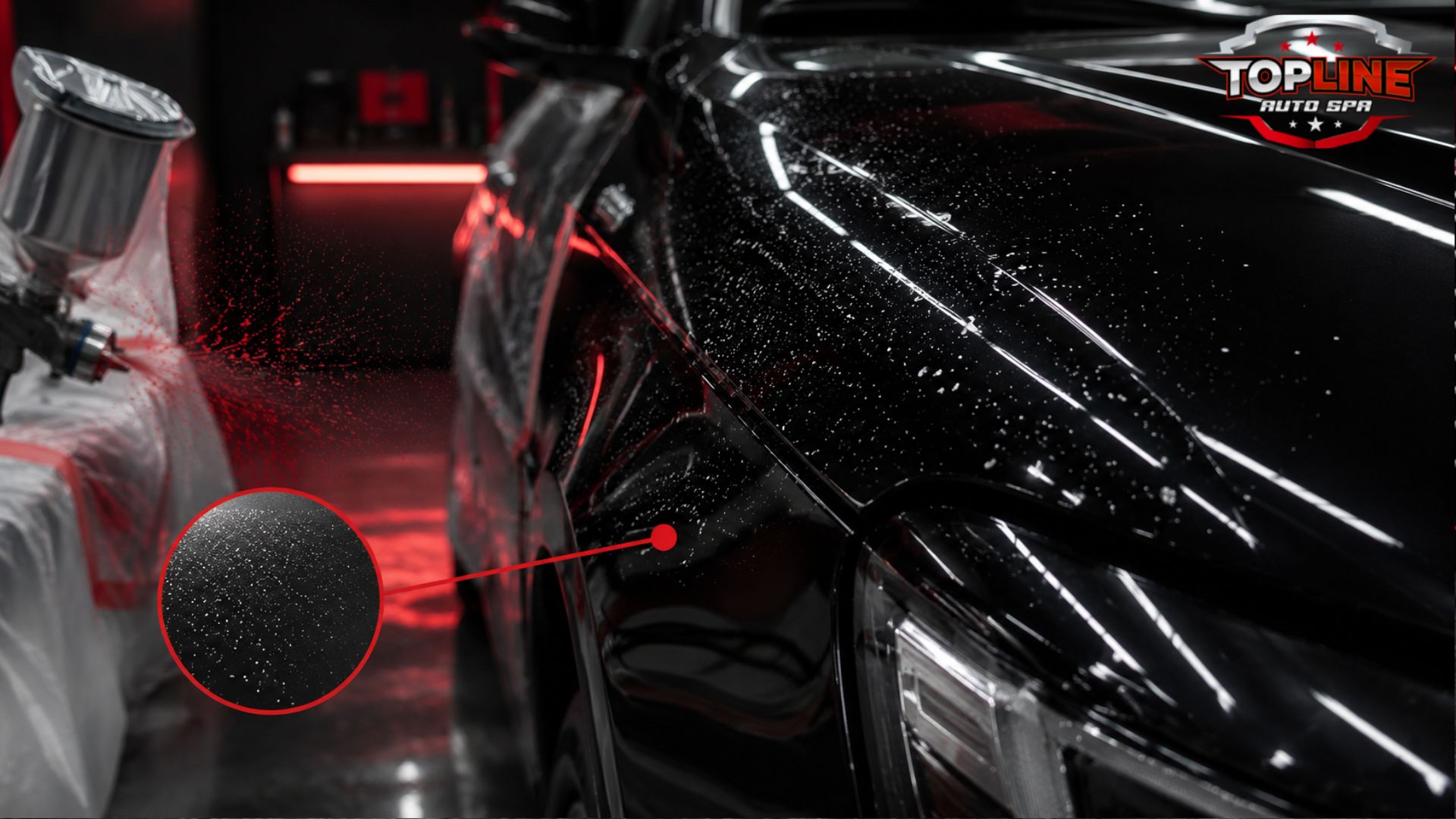
Paint overspray is one of those car problems that you might not notice immediately, but once you do, it becomes frustrating and difficult to ignore. Imagine this scenario: you get your car back from the body shop after work was done, or you park near a construction site, or your neighbor decides to refinish their fence while your vehicle sits in the driveway. Days or weeks later, you notice tiny speckles of paint that shouldn’t be on your vehicle’s finish. These aren’t scratches or dents—they’re literally droplets of paint that have landed on and adhered to your clear coat.
Paint overspray removal isn’t just about aesthetics, though the visual aspect is certainly frustrating. When paint overspray sits on your vehicle’s surface, it actually bonds with your clear coat over time. The longer you wait to address it, the more difficult it becomes to remove without potentially damaging your original finish. This is especially problematic in Lehigh Valley where we have construction activity, auto body shops, and industrial facilities that can contribute to overspray incidents. Professional solutions like paint correction can address overspray safely, but understanding your options helps you make informed decisions about how to proceed.
Understanding what causes paint overspray, why it’s problematic, and what your options are for safe removal helps you address the issue before it causes lasting damage to your vehicle’s finish. Whether the overspray came from a nearby painting project, road construction, or professional auto work, knowing how to handle it properly makes all the difference. This comprehensive guide explores everything you need to know about paint overspray removal, from understanding how overspray happens in the first place, to identifying different types of overspray, to exploring both DIY and professional removal methods. By the end, you’ll have the knowledge to make informed decisions about how to handle this frustrating situation.
Key Takeaways
- Paint overspray removal is different from regular paint damage and requires specific techniques to avoid harming your vehicle’s clear coat
- Overspray occurs when paint droplets from external sources land on and adhere to your vehicle’s exterior finish
- Common causes include nearby construction or painting projects, auto body shop work, and industrial or manufacturing activities in your area
- Paint overspray bonds stronger to clear coat over time, making prompt removal more effective and less risky
- Professional paint correction is often the safest method for removing overspray without damaging your original finish
- DIY methods like clay bar treatment work for light overspray but risk causing damage with improper technique
- Prevention strategies like parking in protected areas and protective coatings can reduce overspray incidents
- Lehigh Valley residents face elevated overspray risk due to construction activity and industrial facilities in the region
- Ignoring overspray can lead to permanent adhesion and require expensive paint correction or repainting
- The cost of professional paint overspray removal is typically much less than the cost of repainting panels due to overspray damage
Understanding Paint Overspray: What It Is and Why It Happens
Paint overspray is a specific type of surface contamination that occurs when airborne paint droplets land on your vehicle and adhere to the clear coat. Unlike dust, dirt, or typical environmental contaminants that sit on the surface and wash away easily, overspray bonds chemically and mechanically with your clear coat.
When paint is applied—whether by spray gun, aerosol can, or any other application method—the process creates a mist of tiny paint droplets. These droplets are suspended in air. In an enclosed professional spray booth, this mist is captured and filtered. But in the open air, these droplets travel until they land on surfaces. If your vehicle happens to be nearby, these droplets land on your finish.
The reason overspray is problematic relates to how paint works. Modern automotive paint consists of basecoat (color) and clear coat (protection and gloss). The clear coat is designed to bond with the basecoat beneath it. When overspray droplets land on the clear coat surface, they begin to bond with that coating in similar ways to how professional paint bonds.
Over time, this bonding becomes stronger. A fresh overspray droplet might wipe away relatively easily. A week-old overspray droplet has bonded more substantially. A month-old overspray droplet has essentially become part of your clear coat. This is why professional auto shops and painters rush to address overspray incidents—the longer overspray sits, the more difficult and risky removal becomes.
The situation gets more complicated when you consider that overspray often affects multiple areas of your vehicle. Overspray doesn’t land neatly in one spot. It spreads randomly wherever the paint mist traveled. You might find overspray on your hood, your side panels, your rear bumper, and your side mirrors simultaneously. This widespread distribution makes removal more time-consuming and complicated than a single spot would be.
Common Causes of Paint Overspray: Identifying the Source
Understanding what causes paint overspray helps you anticipate the risk and take preventive measures. Several situations create paint overspray incidents.
Auto body shops are one of the most common sources. When shops perform repaints—whether for collision repair, touch-ups, or refinishing work—paint overspray can escape from even well-equipped facilities. If you’re having work done and your vehicle sits outside the spray booth, or if the booth isn’t properly isolated, overspray can land on nearby vehicles.
Construction and renovation projects create overspray risks. Contractors painting buildings, refinishing exterior trim, or working on large surfaces generate significant paint mist. If your vehicle is parked nearby, overspray is likely. Fence painting, deck refinishing, and house exterior painting are particularly common sources in residential areas.
Industrial and manufacturing facilities pose overspray risks, especially in areas like Lehigh Valley where manufacturing and industrial activity is common. Factories and facilities painting large equipment or structures generate substantial paint mist that can travel considerable distances depending on wind conditions.
Road construction and maintenance can create overspray incidents. Striping equipment used to paint road lines, marking equipment, and other road-related painting generate paint mist. If you’re driving or parked near active road work, overspray exposure is possible.
Agricultural and commercial equipment operations sometimes contribute to overspray. Equipment painting, maintenance work on large vehicles, and other commercial painting activities can generate mist that lands on nearby vehicles.
Even small DIY projects can contribute to overspray problems. Someone painting their garage, their fence, or their deck with spray equipment can inadvertently overspray neighboring properties. Casual spray painting without proper containment or protection can affect multiple vehicles.
Identifying Paint Overspray: Recognizing the Problem
Recognizing paint overspray early is important because prompt action makes removal easier and safer. Overspray has distinctive characteristics that differentiate it from other types of damage or contamination.
The most obvious sign is random tiny droplets or speckles of paint on your vehicle’s surface. These droplets are usually noticeable when you look closely, though depending on paint color and overspray paint color, they might be more or less obvious. White or light-colored overspray on dark vehicle paint is immediately visible. Dark overspray on light vehicle paint is also obvious. Same-color overspray is more subtle and requires closer inspection.
Overspray droplets feel different from the rest of your paint. When you run your hand across overspray, you can feel the raised texture. The droplets create a bumpy sensation under your fingers. This tactile difference is often how people first notice overspray—by feel rather than by sight.
Overspray distribution is typically random rather than directional. You won’t see overspray in neat lines or patterns. Instead, it’s scattered across multiple areas of your vehicle’s exterior. The pattern reflects how the wind carried the paint mist rather than any logical automotive damage pattern.
The amount of overspray varies. Light overspray might consist of a few scattered droplets barely visible except under close inspection. Heavy overspray might cover significant portions of your vehicle’s exterior with concentrated paint droplets. Very heavy overspray can make a vehicle look almost speckled or spotted.
Location matters too. Overspray commonly affects areas that were exposed when the incident occurred. If your vehicle was parked in an open lot during an overspray incident, all exposed surfaces get hit. If your vehicle was partially sheltered—like under a carport—the sheltered areas remain clean while exposed areas show heavy overspray.
The Chemistry of Overspray Bonding: Why It’s Difficult to Remove
Understanding the chemistry of why overspray bonds so stubbornly to your clear coat helps explain why professional paint overspray removal exists as a specialized service.
Paint consists of pigments (which provide color), binders (which hold the paint together), and solvents (which allow paint to flow). When paint is sprayed, the solvents evaporate as the paint travels through the air, and the paint begins to set. By the time overspray droplets land on your vehicle, they’re already partially set—the solvents have mostly evaporated, but the paint is still tacky and reactive.
When these semi-set paint droplets land on your clear coat, they encounter another painted surface with similar chemistry. The paint in the droplets and the paint in the clear coat begin to interact. The remaining solvents in the overspray droplets can actually soften the clear coat slightly, allowing better bonding between the two paint layers.
Over time, as remaining solvents fully evaporate and the overspray droplet completely cures, it becomes increasingly bonded with the clear coat beneath. The mechanical bonding (physical adhesion) combines with chemical bonding (molecular interaction between the paints). This dual bonding is why freshly fallen overspray might wipe away with gentle effort, while month-old overspray requires more aggressive removal techniques.
The color and type of overspray paint affects removal difficulty. Overspray from spray cans, professional industrial paints, or specialized automotive finishes bond differently. Some paint types bond more aggressively than others. Metallic or pearlescent overspray, which contains reflective particles, sometimes bonds more stubbornly than solid-color overspray.
Temperature and humidity also affect overspray bonding. Warm temperatures accelerate the curing process, causing overspray to bond faster. Humidity can either help or hinder bonding depending on specific conditions. This is why overspray from summer painting projects often bonds faster than overspray from winter projects—the warm weather accelerates the chemical reactions.
Professional Paint Overspray Removal: The Safe and Effective Approach
Professional paint correction specialists have multiple sophisticated methods for removing paint overspray without damaging your vehicle’s clear coat. Professional removal is particularly important for moderate to heavy overspray or for overspray that’s been present for extended periods.
Professional detailing shops equipped for paint correction typically begin with thorough assessment of your overspray situation. They evaluate the type of overspray, how long it’s been present, how much area is affected, and what type of paint your vehicle has. This assessment determines which removal techniques will be most effective.
When you need professional help with overspray that’s bonded strongly to your clear coat, professional paint correction specialists use specialized techniques. One professional approach involves using specialized paint overspray removal products specifically engineered for safe overspray removal. These products are formulated to soften overspray while minimizing clear coat interaction. Professional technicians apply these products carefully to affected areas, allowing sufficient dwell time for effectiveness, then gently remove the softened overspray.
Another professional technique involves controlled light polishing. Professional-grade polishing equipment used at controlled speeds with appropriate polishing compounds can remove overspray while removing only minimal clear coat. The key difference from DIY attempts is that professionals understand exactly how much aggressive action is safe, have equipment that maintains consistent control, and can stop immediately if they encounter issues.
Some professional shops use wet sanding for very stubborn overspray. Wet sanding involves using extremely fine sandpaper (often 2000 grit or higher) in combination with water or lubricant to remove overspray. This is an aggressive technique that must be performed extremely carefully to avoid removing too much clear coat, which is why it’s strictly a professional procedure.
In some cases, professional technicians use a combination of techniques. They might start with a gentler method, assess results, then progress to more aggressive approaches only if necessary. This layered approach minimizes clear coat risk by never using more aggressive techniques than necessary.
The advantage of professional paint overspray removal is that technicians have extensive experience judging how much aggressive removal is safe and when to stop. They have proper equipment and products engineered for safe removal. They typically warranty their work, meaning if overspray isn’t completely removed, they’ll continue working until it is.
DIY Methods for Light Paint Overspray Removal: When and How
For light, freshly-occurred overspray, DIY methods can sometimes work, though caution is essential to avoid damaging your clear coat. These methods work best on recent overspray that hasn’t had time to develop maximum bonding.
Clay bar treatment is the most common DIY approach for light overspray. Clay bar—a specially formulated decontaminant product—can remove light overspray if applied properly. The clay works by having the overspray droplets adhere to the clay rather than remaining on your clear coat.
The process involves lubricating your vehicle’s surface with a slip solution (included with most clay bar kits), then gently working the clay over the affected areas. The clay picks up the overspray droplets as you work. The key word is “gently”—aggressive clay bar use can actually scratch your clear coat or damage your paint more than the overspray does.
Clay bar is most effective on very fresh overspray where bonding hasn’t reached full strength. For overspray more than a week old, clay bar becomes less effective because the overspray has bonded more substantially with the clear coat.
Rubbing compound is another DIY option, though it’s more aggressive than clay bar and carries higher risk of damaging your clear coat if not applied correctly. Rubbing compound actually removes a thin layer of clear coat along with the overspray. This approach is sometimes effective but can compromise your clear coat’s protective properties if done incorrectly.
Isopropyl alcohol applied with a soft microfiber cloth can sometimes soften overspray enough for gentle removal, particularly if the overspray is very fresh. The alcohol temporarily softens the overspray droplets, allowing them to wipe away. However, this method only works on very recent overspray and requires extreme gentleness.
The critical caution with all DIY methods is that improper technique can cause more damage than the overspray itself. Your clear coat is your vehicle’s protection against UV damage, oxidation, and environmental contaminants. Aggressive removal methods can thin the clear coat, creating dull spots, soft areas, or uneven gloss. Once the clear coat is damaged, paint correction or repainting becomes necessary—a much more expensive solution than professional overspray removal.
If you want to learn more about safely removing paint contaminants from your vehicle, check out our guide on how to get road paint off a car safely, which covers similar paint removal challenges and prevention strategies.
Prevention: Reducing Paint Overspray Risk
While overspray removal is important for addressing existing problems, prevention is always preferable. Several strategies reduce your overspray exposure risk.
Garaged parking is the most effective prevention. If your vehicle is stored in a garage or covered structure, it’s protected from airborne overspray. In Lehigh Valley where weather varies and construction is common, garaged parking provides protection from multiple hazards including overspray, UV exposure, and weather damage.
Covered parking or carports provide partial protection. While not as complete as a garage, covered parking reduces exposure to falling or airborne paint mist from overhead sources.
Awareness of nearby painting and construction projects helps you relocate your vehicle if possible. If you know someone nearby is planning a major painting project, parking your vehicle elsewhere during the work reduces risk.
Protective coverings like car covers can protect against overspray, though covers must be properly fitted to avoid trapping moisture that could damage your paint. Professional-grade breathable car covers are preferable to inexpensive alternatives that might trap moisture.
If you’re concerned about future overspray incidents and want maximum protection for your vehicle’s finish, consider paint protection film for vulnerable areas. Paint protection film creates a sacrificial layer on your hood, bumper, and fenders where overspray exposure is most likely. For additional durability and appearance protection, ceramic coating provides a hydrophobic surface that makes overspray less likely to bond aggressively.
Regular inspection of your vehicle helps catch overspray early. Early detection means fresher overspray that bonds less strongly, making removal easier and less risky.
Dealing with Overspray from Body Shop Work
When overspray occurs as a result of professional body shop work on your vehicle, the shop bears responsibility for removing it. Professional standards expect shops to protect your vehicle and other surrounding vehicles from overspray.
If you receive your vehicle back from body shop work with overspray on areas that weren’t being painted, that’s a legitimate complaint. Professional body shops should have prevented this through proper masking, containment, or booth preparation.
Your first step should be communicating with the shop. Professional shops expect occasional overspray incidents and typically have procedures for addressing them. Most reputable shops will address overspray at no charge, viewing it as part of their professional responsibility.
Document the overspray with photos before contacting the shop. This provides clear evidence of the problem and helps facilitate discussion.
If the shop refuses to address overspray, you have options. You can pursue DIY removal methods at your own risk, seek professional paint correction elsewhere and send the bill to the shop, or in cases of severe overspray, pursue legal action or file complaints with appropriate consumer protection agencies.
For future body shop work, discuss overspray prevention with shops upfront. Ask what measures they take to prevent overspray on customer vehicles. This conversation sometimes encourages shops to take extra care knowing you’re aware of the issue.
Overspray and Vehicle Warranty Implications
Understanding how overspray and overspray removal affect your vehicle’s warranty is important if your vehicle is under manufacturer warranty.
Overspray itself doesn’t typically void warranty coverage. Manufacturer warranties don’t cover overspray as a defect or manufacturing issue—overspray is environmental damage. However, the warranty typically covers your vehicle’s components and systems, not cosmetic paint issues resulting from environmental incidents.
However, DIY removal attempts that damage your clear coat could affect warranty coverage. Some manufacturers void warranty for certain types of damage if they determine the damage resulted from improper maintenance or treatment. Aggressive DIY paint removal methods might fall into this category if they damage your clear coat.
This is another reason professional paint overspray removal is preferable for vehicles under warranty. Professional removal methods are least likely to cause damage that could complicate warranty interactions. If damage somehow occurs during professional removal, the shop’s insurance typically covers the liability.
For vehicles under extended warranty or paint protection plans, review your policy language regarding overspray. Some plans cover paint damage resulting from environmental incidents like overspray. Others specifically exclude overspray damage. Knowing your coverage helps you make informed decisions about removal methods and whether professional coverage applies.
Lehigh Valley-Specific Overspray Risks
Lehigh Valley residents face specific overspray risks due to regional characteristics including industrial activity, construction projects, and road maintenance.
Industrial facilities in Lehigh Valley engage in painting and finishing operations that can generate overspray. Metal fabrication, equipment manufacturing, and industrial paint shops are common in our region. Vehicles parked near these facilities or downwind during active painting operations risk overspray exposure.
Construction activity in the region includes building renovation, new construction, commercial projects, and infrastructure work. Road construction and maintenance, which involves painting road lines and markings, generates significant paint mist. Vehicles on or near construction sites risk overspray exposure.
Weather patterns in Lehigh Valley affect overspray distribution. Our wind patterns can carry paint mist considerable distances from the source. Overspray incidents sometimes occur miles away from the painting source due to wind carrying the mist.
Temperature and humidity in our region affect how quickly overspray bonds. Summer heat accelerates curing, making summer overspray particularly problematic. High humidity can either facilitate or inhibit bonding depending on specific conditions.
For Lehigh Valley residents, being aware of regional overspray risks helps with prevention. Awareness of nearby industrial or construction activity allows relocating your vehicle if possible. Garaged or covered parking becomes particularly valuable during periods of active construction or industrial painting in your area.
Overspray Removal Cost Analysis: DIY vs. Professional
Understanding the cost implications of different overspray removal approaches helps you make economically sensible decisions.
DIY clay bar treatment is inexpensive—clay bar kits typically cost $10-25. However, the risk is that improper technique could damage your clear coat, necessitating professional paint correction costing $300-800+ depending on damage severity.
DIY rubbing compound costs $15-40 per container but carries higher risk of clear coat damage than clay bar. If aggressive rubbing damages your clear coat, the paint correction bill becomes substantial.
Professional paint overspray removal typically costs $150-500 depending on how much overspray needs removal and how stubborn the overspray is. Light overspray affecting small areas might be $150-250. Moderate to heavy overspray affecting larger areas might be $300-500. Very heavy overspray might exceed $500 if extensive work is required.
This professional cost should be compared against the risk of DIY damage. If DIY removal goes wrong and damages clear coat, professional paint correction to repair that damage costs $300-1000+ depending on severity. The gamble of saving $100-300 on removal when you risk $500+ in damage correction is economically unsound.
Additionally, professional removal typically provides warranty. If overspray isn’t completely removed after professional work, the shop will continue working to remove it. DIY attempts offer no such guarantee.
For light overspray on recent incidents, careful DIY clay bar treatment might be appropriate for budget-conscious vehicle owners willing to accept modest risk. For anything beyond light overspray, or for overspray that’s been present more than a few days, professional removal is economically justified and much safer.
Conclusion: Prompt Paint Overspray Removal Protects Your Investment
Paint overspray removal is one of those vehicle maintenance issues that seems minor until you recognize how much it can impact your vehicle’s appearance and long-term paint condition. Understanding what causes overspray, recognizing it early, and addressing it promptly prevents situations where a minor cosmetic issue becomes a serious paint problem requiring expensive correction or repainting.
The key insight is that overspray bonds stronger to your clear coat over time. Fresh overspray might wipe away with gentle effort. Week-old overspray requires more aggressive removal techniques. Month-old overspray becomes progressively more difficult to remove without risking clear coat damage. This time factor makes prompt action critical.
For light, recently-occurred overspray, careful DIY clay bar treatment might be appropriate for budget-conscious vehicle owners. However, for moderate to heavy overspray, or for overspray that’s been present more than a week, professional paint correction is safer and often more cost-effective when you factor in the risk of DIY damage.
Lehigh Valley residents face elevated overspray risk due to regional industrial activity, construction projects, and road maintenance. Being aware of these risks and taking preventive measures—garaged parking, protective coatings, vehicle awareness—reduces the probability of overspray incidents. If you want the ultimate protection for your vehicle, ceramic coating combined with paint protection film on high-risk areas provides excellent safeguards against future overspray problems while maintaining your paint’s appearance and protective properties.
Your vehicle’s paint isn’t just about aesthetics. It protects the underlying metal from rust and corrosion. Paint overspray removal protects both the appearance you value and the long-term integrity of your vehicle’s finish. For comprehensive paint care and protection, professional paint correction and protective treatments ensure your vehicle maintains its value and appearance for years to come.
Frequently Asked Questions
1. How quickly does paint overspray bond to my clear coat?
Paint overspray begins bonding immediately upon landing on your clear coat, but the bonding strengthens over hours and days. Very fresh overspray (hours old) might respond to gentle methods like careful wiping or clay bar treatment. Within 24-48 hours, bonding becomes noticeably stronger. After a week, overspray has developed substantial bonding requiring more aggressive removal techniques. After a month, overspray bonding is very strong and removal becomes risky without professional equipment and expertise. This time factor makes prompt action critical—the sooner you address overspray, the easier and safer removal becomes.
2. Can I just wash my car to remove paint overspray?
Regular car washing won’t remove paint overspray. Overspray bonds with your clear coat—it’s not just surface contamination that water and soap can dissolve. Washing might remove loose dust from overspray but won’t remove the paint droplets themselves. Some people try aggressive washing or rubbing during car washing, but this can damage your clear coat without effectively removing overspray. Professional clay bar treatment or professional removal methods are necessary because they address the actual bonding rather than just trying to wash it away.
3. Will clay bar damage my clear coat if used incorrectly?
Yes, improper clay bar use can damage your clear coat. Clay bar is abrasive and can scratch clear coat if used with insufficient lubrication, too much pressure, or in contaminated areas where grit particles can scratch. The key to safe clay bar use is proper lubrication with a slip solution, gentle pressure, and proper technique. Many vehicle owners damage their clear coat attempting DIY clay bar treatment for overspray removal. Professional technicians know exactly how much pressure is safe and can stop immediately if they encounter risk. This is why professional removal is safer for anything beyond the lightest overspray.
4. Is paint overspray removal expensive?
Professional paint overspray removal typically costs $150-500 depending on overspray severity. Light overspray affecting small areas might be $150-250. Moderate to heavy overspray might be $300-500. While this isn’t free, it’s much cheaper than the alternative—if DIY removal damages your clear coat, professional paint correction costs $300-1000+. Additionally, if overspray causes damage that requires repainting panels, costs exceed $1000+ per panel. Viewed this way, professional overspray removal is cost-effective prevention against much more expensive paint damage.
5. What happens if I leave paint overspray on my car for months?
If you leave paint overspray for months, it continues bonding with your clear coat and becomes progressively more difficult to remove. Eventually, overspray essentially becomes part of your clear coat—removal requires removing enough clear coat to eliminate the overspray, which damages your paint’s protection. Extreme cases might require repainting affected panels because overspray bonding and removal attempts have compromised the clear coat beyond safe restoration. Additionally, overspray sitting on your paint can trap moisture and potentially facilitate corrosion in some situations. The longer overspray sits, the more likely it creates secondary damage beyond the overspray itself.
6. Can a body shop remove overspray if I had work done there?
Yes, a professional body shop should remove overspray if it resulted from work they performed. Professional standards expect shops to protect your vehicle from overspray. If overspray occurred on areas they weren’t painting, that’s a shop responsibility. Contact the shop and document the problem with photos. Reputable shops address overspray at no charge, viewing it as part of their professional responsibility. If the shop refuses, you can pursue professional removal elsewhere and send the bill to the shop, or escalate through consumer protection channels.
7. Does paint overspray void my vehicle’s warranty?
Overspray itself doesn’t typically void your manufacturer warranty. However, DIY removal attempts that damage your clear coat might affect warranty coverage. Aggressive DIY removal methods that damage clear coat could be viewed as improper maintenance. Professional overspray removal is warranty-safe because professional techniques minimize clear coat risk. Additionally, some extended warranties or paint protection plans cover environmental paint damage including overspray. Review your warranty documentation to understand your coverage.
8. What’s the difference between light, moderate, and heavy paint overspray?
Light overspray consists of a few scattered droplets affecting small areas, typically appearing relatively fresh. Light overspray sometimes responds to gentle clay bar treatment. Moderate overspray covers larger areas or consists of many droplets across multiple areas of your vehicle. Moderate overspray has been present long enough that bonding has developed substantially. Heavy overspray covers significant portions of your vehicle with concentrated paint droplets, appearing very speckled or spotted. Very heavy overspray indicates either extreme proximity to the overspray source or extended exposure. Removal difficulty increases significantly with overspray severity.
9. Can protective coatings like ceramic coating prevent paint overspray?
Protective coatings like ceramic coating or paint protection film don’t prevent overspray, but they reduce how aggressively overspray bonds. Ceramic coating’s hydrophobic surface makes overspray less likely to bond as strongly as it would to uncoated clear coat. Paint protection film creates a sacrificial layer that overspray lands on instead of your clear coat. While overspray can still occur on these protected surfaces, removal becomes easier because the overspray is bonded to the coating rather than directly to your clear coat. For maximum protection, paint protection film on high-risk areas (hood, bumper, fenders) combined with ceramic coating on entire paint provides the best overspray protection.
10. How can I prevent paint overspray in Lehigh Valley?
Lehigh Valley-specific prevention strategies include garaged or covered parking to protect your vehicle from airborne paint mist. Awareness of nearby industrial or construction activity allows relocating your vehicle if possible. Parking away from active construction sites, painting projects, and manufacturing facilities reduces exposure. Protective coatings like paint protection film on vulnerable areas provide sacrificial protection. Regular inspection helps catch fresh overspray early when removal is easier and safer. During periods of active construction or industrial painting in your area, extra vigilance helps identify overspray before it has time to bond strongly to your clear coat.